
If an impaired driver causes a crash in Richmond, the injured person may have rights in two separate legal processes: a criminal DUI prosecution brought by the Commonwealth and a civil or insurance claim seeking compensation for the victim’s losses.
Virginia law may also permit punitive damages in certain drunk driving cases, but they are not automatic. The evidence must satisfy specific legal requirements concerning the driver’s intoxication, knowledge, conduct and the cause of the collision.
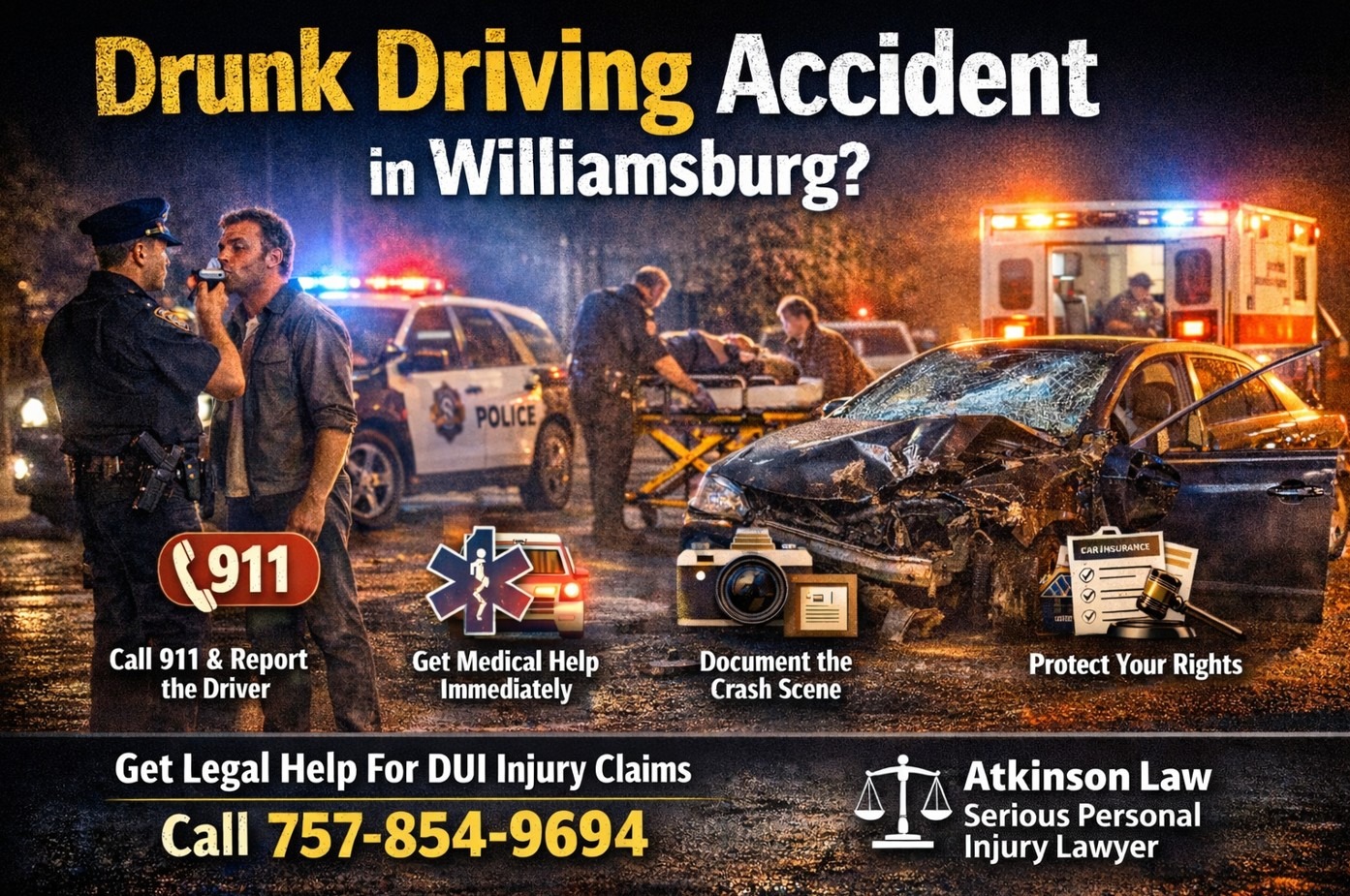
After a suspected drunk driving accident:
- Call 911 and obtain emergency assistance.
- Report suspected impairment to law enforcement.
- Obtain emergency and follow-up medical care.
- Document the vehicles, road, witnesses and visible evidence.
- Preserve the police, criminal-court and toxicology records.
- Notify the appropriate insurance companies accurately.
- Review uninsured and underinsured motorist coverage.
- Contact Richmond Victim Witness Services when criminal charges are filed.
- Consider the Virginia Victims Fund for qualifying unreimbursed losses.
- Track the separate civil filing deadline.
A Richmond drunk driving accident lawyer can review the collision evidence, insurance policies, criminal case and potential civil claims. Legal representation does not guarantee compensation or punitive damages.
What Is Drunk or Drug-Impaired Driving Under Virginia Law?
Under Virginia Code § 18.2-266, it is unlawful to drive or operate a motor vehicle:
- With a blood alcohol concentration of at least 0.08%;
- While under the influence of alcohol;
- While impaired by a narcotic drug, self-administered intoxicant or another drug;
- While impaired by a combination of alcohol and drugs; or
- With certain listed drugs in the blood at or above the statutory concentration.
A BAC below 0.08% does not automatically establish that the driver was legally unimpaired. Virginia law separately prohibits operating while under the influence to a degree that impairs safe driving.
Get a free legal consultation
CALL 757-648-8579Why Can Impaired Driving Collisions Be Particularly Serious?
Alcohol and drug impairment may affect judgment, reaction time, attention, coordination and the ability to respond safely to traffic conditions.
An impaired driver may:
- Misjudge speed or distance
- Drift from the travel lane
- Fail to yield
- Ignore a traffic signal or sign
- Follow another vehicle too closely
- Brake too late
- Drive in the wrong direction
- Accelerate or turn unpredictably
These behaviours may contribute to rear-end, head-on, side-impact, pedestrian, motorcycle and multi-vehicle collisions.
Richmond crashes may occur on Interstate 95, Interstate 64, Broad Street, Hull Street, Midlothian Turnpike and other city roads. The location alone does not prove impairment or liability; the individual evidence must be examined.
What Should You Do Immediately After a Suspected DUI Crash?
Call 911
Request police and emergency medical assistance when anyone appears injured, a vehicle blocks traffic, a driver attempts to leave or you suspect alcohol or drug impairment.
Tell the dispatcher about observable conduct, such as:
- Slurred speech
- Difficulty standing
- Confusion
- An alcohol odour
- Open containers
- Erratic driving before the collision
- An attempt to leave the scene
Report what you personally observed. Do not exaggerate or diagnose intoxication yourself.
Obtain medical care
Your health should remain the priority. Accept emergency evaluation when recommended and contact a healthcare professional if new or worsening symptoms appear.
Potential injuries include:
- Traumatic brain injuries
- Spinal cord injuries
- Neck and back injuries
- Broken bones
- Chest or abdominal injuries
- Internal bleeding
- Nerve injuries
- Soft-tissue injuries
- Scarring or disfigurement
- Psychological trauma
Learn more about serious neurological injuries through Atkinson Law’s resources concerning Richmond brain injury claims and Richmond spinal cord injury claims.
Document the scene when it is safe
Photograph or record:
- Every vehicle involved
- Vehicle positions and points of impact
- Skid marks, debris and fluid trails
- Traffic signs, signals and lane markings
- Road, lighting and weather conditions
- Visible injuries
- Open containers visible from a lawful location
- Nearby businesses, residences or traffic cameras
Do not enter another vehicle or handle suspected alcohol, drugs or containers. Allow police to preserve and collect potential criminal evidence.
Identify witnesses
Obtain each witness’s name, telephone number and email address. Ask what the person observed, but do not suggest what they should say.
A witness may have observed:
- Erratic driving before the collision
- The driver consuming alcohol
- The driver’s speech, balance or conduct
- Statements made after the crash
- An attempt to hide evidence or leave
Contact our personal injury lawyers today
GET FREE EVALUATIONThe Criminal DUI Case and Civil Injury Claim Are Separate
| Criminal DUI proceeding | Civil or insurance claim |
|---|---|
| Brought by the Commonwealth | Brought by or for the injured person |
| Seeks criminal penalties | Seeks compensation for legally recoverable losses |
| May involve jail, fines and licence consequences | May involve insurance payment, settlement or a civil judgment |
| Requires proof under the criminal standard | Uses the civil burden of proof |
| Controlled by the prosecutor | Settlement decisions generally belong to the civil claimant |
| May include restitution | May include broader compensatory and, in some cases, punitive damages |
The criminal court does not ordinarily negotiate or settle the victim’s complete civil personal injury claim.
Likewise, accepting an insurance settlement does not necessarily determine the criminal charge. The release should nevertheless be reviewed for any cooperation, confidentiality or other provisions affecting the victim.
Do You Need a DUI Conviction to Bring a Civil Claim?
Not necessarily. A civil claim generally focuses on whether the driver was negligent or otherwise legally responsible, whether that conduct caused the collision and whether the collision caused the claimed losses.
Potential civil evidence may include:
- Police crash reports
- Officer observations
- Field sobriety evidence
- Breath or blood test results
- A refusal determination
- Body-camera and dashboard-camera footage
- 911 recordings
- Witness statements
- Surveillance video
- Vehicle data
- Criminal court records
- The driver’s admissions
A guilty plea or conviction may be important evidence, but the civil claim should be investigated independently and within its own filing deadline.
What if the Driver Was Impaired by Drugs Instead of Alcohol?
Virginia’s DUI statute covers impairment caused by alcohol, drugs or a combination of substances.
Relevant evidence may include:
- Blood toxicology results
- Prescription records obtained through lawful process
- Drug-recognition evidence
- Officer observations
- Statements by the driver
- Drugs or paraphernalia lawfully recovered from the vehicle
- Video showing the driver’s condition or behaviour
The statutory 0.15% BAC pathway for punitive damages concerns alcohol. A drug-impaired driving case may require a different analysis to prove malicious, willful or wanton conduct.
Who May Be Liable for the Richmond DUI Collision?
The impaired driver is often the primary defendant, but another person or business may also require investigation.
Potentially responsible parties may include:
- The impaired driver
- Another driver who contributed to a multi-vehicle crash
- The vehicle owner under an applicable legal theory
- An employer when the driver was acting within the scope of employment
- A rideshare, delivery or commercial insurer when its policy applies
- A vehicle or component manufacturer when a defect contributed to the injuries
- A government entity responsible for a dangerous road condition, subject to special requirements
A relationship with the driver does not automatically create liability. Each potential defendant requires a recognised legal basis supported by evidence.
What Must a Victim Prove in a Civil Claim?
A civil negligence claim generally requires evidence that:
- The defendant owed a legal duty.
- The defendant breached that duty.
- The breach proximately caused the collision and injury.
- The claimant sustained legally recoverable damages.
Evidence of intoxication may support the claim, but the claimant must still connect the impaired conduct to the collision and claimed losses.
Can Richmond DUI Victims Recover Punitive Damages?
Potentially. Punitive damages are intended to punish and deter sufficiently serious conduct. They are different from compensatory damages, which address the claimant’s losses.
Under Virginia Code § 8.01-44.5, punitive damages may be awarded when the evidence proves malice or conduct so willful or wanton that it shows a conscious disregard for the rights of others.
The 0.15% BAC pathway
The statute treats the conduct as sufficiently willful or wanton when the evidence establishes that:
- The driver had a BAC of at least 0.15% when the incident occurred;
- The driver knew or should have known that alcohol impaired or would impair the ability to operate safely; and
- The intoxication proximately caused the injury or death.
A properly administered test certificate may create a rebuttable presumption concerning the driver’s BAC at the time of the collision.
Unreasonable refusal to submit to testing
Virginia also provides a statutory pathway when a driver unreasonably refused a required alcohol test.
The claimant must present evidence that:
- The driver was intoxicated when the crash occurred;
- The driver knew or should have known that the alcohol impaired the ability to drive; and
- The intoxication proximately caused the injury or death.
A refusal does not automatically prove every required element.
Are punitive damages guaranteed when BAC was 0.15%?
No. The evidence must satisfy every statutory element, and the finder of fact retains discretion over whether to award punitive damages.
Virginia’s punitive-damages cap
Under Virginia Code § 8.01-38.1, total punitive damages against all liable defendants generally cannot exceed $350,000.
What Compensatory Damages May Be Available?
If liability and causation are established, potentially recoverable losses may include:
- Emergency medical treatment
- Hospital and surgical expenses
- Past medical care
- Reasonably anticipated future treatment
- Physical and occupational rehabilitation
- Lost income
- Reduced earning capacity
- Physical pain and inconvenience
- Permanent impairment
- Scarring or disfigurement
- Vehicle and personal-property damage
- Other losses recoverable under Virginia law
Compensation is not automatic. The claimed losses must be supported by medical, employment, financial and other evidence.
What Insurance May Apply After a Drunk Driving Crash?
The impaired driver’s liability insurance
The driver’s liability policy may cover bodily injury and property damage up to its limits, subject to the policy and the evidence establishing legal responsibility.
For Virginia policies effective on or after January 1, 2025, ordinary minimum liability limits are:
- $50,000 for bodily injury or death to one person
- $100,000 for bodily injury or death to two or more people in one accident
- $25,000 for property damage
These are minimum limits—not guaranteed payments or measures of the claim’s value.
Uninsured motorist coverage
Uninsured motorist coverage may apply when the responsible driver:
- Has no qualifying liability insurance;
- Cannot be identified;
- Has coverage that is denied; or
- Falls within another statutory uninsured category.
Underinsured motorist coverage
Underinsured motorist coverage may apply when the liability insurance available for payment is less than the victim’s supported damages.
Current Virginia law generally provides add-on UIM benefits without deducting the available liability coverage unless a named insured signed an election allowing the UIM insurer to apply that reduction.
Obtain and review:
- The declarations page
- The complete policy
- UIM endorsements
- Signed reduction elections
- Policies covering other household or occupied vehicles
Other potential coverage
Depending on the facts, coverage may also include:
- Medical-expense benefits
- Income-loss benefits
- Collision coverage
- Employer or commercial coverage
- Rideshare or delivery coverage
- Excess or umbrella insurance
Do not sign a liability release before determining whether the language and settlement procedure preserve any applicable UIM claim.
What if the Driver Has Too Little Insurance?
A severe drunk driving collision may produce damages greater than the impaired driver’s insurance limit.
Potential additional recovery sources may include:
- Applicable UIM coverage
- An excess or umbrella policy
- A commercial or employer policy
- Another negligent driver
- A separately liable person or company
- The defendant’s collectible nonexempt assets
A judgment exceeding the insurance limit does not guarantee collection of the remaining amount. The defendant’s assets, income, exemptions and financial condition must be considered.
What Is Criminal Restitution?
When the impaired driver is convicted, the criminal court may order restitution for qualifying losses caused by the crime.
Potential restitution may include:
- Property damage or loss
- Medical expenses
- Funeral or burial expenses
Restitution is not automatic, and the amount collected may depend on the criminal sentence and defendant’s ability to pay.
Restitution also does not necessarily include every category of damage available in a civil personal injury or wrongful death claim.
Can a DUI Crash Victim Apply to the Virginia Victims Fund?
Potentially. Virginia’s crime-victim compensation statutes treat injuries resulting from a violation of Virginia’s DUI law as injuries resulting from a qualifying crime.
The Virginia Victims Fund may provide assistance for qualifying unreimbursed expenses, including:
- Medical costs
- Certain lost earnings
- Necessary services
- Funeral or burial expenses
- Other eligible crime-related losses
The program is generally a payer of last resort. Awards are reduced by insurance, restitution and other public or private payment sources.
Claims generally must be filed within three years after the crime or the victim’s death. Current Virginia law generally limits the aggregate award for injury or death to $35,000 after applicable reductions.
Prompt police reporting is ordinarily required, although the Commission considers the victim’s circumstances when evaluating whether reporting was prompt.
Richmond Victim Witness Services
The Richmond Commonwealth’s Attorney’s Victim Witness Services Program assists crime victims and witnesses through the criminal justice process.
Services may include:
- Court-date notifications
- Case-disposition information
- Explanation of victim rights
- Referrals for counselling or other services
- Help completing Virginia Victims Fund applications
- Information concerning offender custody or release
The City of Richmond currently lists Victim Witness Services at 804-646-7665. Confirm the current number and office information on the official Richmond Victim Witness Services page.
What Rights Do Crime Victims Have?
Virginia crime victims may have rights to fairness, dignity, notice, information, protection, restitution and participation in the criminal justice process as provided by law.
Depending on the case, these rights may include:
- Receiving notice of court proceedings
- Conferring with the prosecution
- Being informed about case disposition
- Addressing the court at sentencing
- Seeking restitution
- Receiving notice of release or escape
These rights concern the criminal proceeding and do not themselves create a civil damages action against the Commonwealth.
Should You Give an Insurance Adjuster a Recorded Statement?
Do not use a universal rule that every recorded statement must be refused.
Your own insurer may require reasonable cooperation under your policy. A request from the impaired driver’s liability insurer raises different considerations.
Before agreeing, ask:
- Which insurer is requesting the statement?
- Whom does the insurer represent?
- Which policy and claim number apply?
- Whether the statement is required under your policy
- How the recording will be used
- Whether you will receive a copy or transcript
Be truthful and concise. Do not guess about:
- Vehicle speed or distance
- The impaired driver’s exact alcohol consumption
- Fault
- Your medical diagnosis
- Your future recovery
What Evidence Should Be Preserved?
Potentially important evidence includes:
- Police crash and DUI reports
- Officer body-camera and dashboard-camera footage
- 911 recordings
- Breath or blood test certificates
- Search-warrant and laboratory records
- Refusal-hearing records
- Criminal charging and court documents
- Scene photographs and video
- Traffic-camera and surveillance recordings
- Witness information
- Vehicle event data
- Medical records and bills
- Employment and income records
- Insurance policies and correspondence
Some video and electronic evidence may be overwritten routinely. Preservation requests may need to be sent promptly.
Does Virginia’s Contributory-Negligence Rule Apply?
Yes. Virginia generally follows contributory negligence in ordinary negligence cases.
The defence may argue that the injured person’s own negligence contributed to causing the collision. Potential allegations may include:
- Speeding
- Failing to maintain a proper lookout
- Following too closely
- Making an unsafe lane change
- Ignoring a traffic signal
- Driving while distracted or impaired
The fact that the other driver was intoxicated does not automatically eliminate every possible contributory-negligence defence.
However, an insurance company’s allegation is not proof. The conduct must be established and connected to the cause of the collision.
Fatal Drunk Driving Accidents in Richmond
When a victim dies because of a drunk driving collision, a Virginia wrongful death action generally must be brought by the decedent’s personal representative.
Potential wrongful death damages may include:
- Sorrow, mental anguish and solace
- Loss of expected income
- Loss of services, care, protection and assistance
- Final medical expenses related to the fatal injury
- Reasonable funeral expenses
- Punitive damages when the legal standard is met
Learn more through Atkinson Law’s information about working with a Richmond wrongful death lawyer.
How Long Do Richmond DUI Victims Have to File?
Personal injury claims
Under Virginia Code § 8.01-243, a personal injury action generally must be filed within two years after the cause of action accrues.
Property-damage claims
An action involving damage to property generally must be filed within five years.
Wrongful death claims
Under Virginia Code § 8.01-244, a wrongful death action generally must be brought by the personal representative within two years after death.
Virginia Victims Fund claims
A Virginia Victims Fund application generally must be submitted within three years after the qualifying crime or the victim’s death.
Different deadlines, notice requirements or exceptions may apply when:
- The victim is a minor or incapacitated person.
- A government vehicle or roadway is involved.
- The responsible driver cannot be identified.
- Another statutory circumstance applies.
A pending criminal prosecution, plea negotiation, insurance investigation or restitution request does not necessarily extend the civil lawsuit deadline.
When May a Drunk Driving Accident Lawyer Be Helpful?
Not every minor collision requires legal representation. Legal advice may be particularly useful when:
- The injuries are serious or permanent.
- The driver’s BAC was allegedly 0.15% or higher.
- The driver refused alcohol testing.
- The criminal and civil evidence must be coordinated.
- Punitive damages may be available.
- Several people were injured.
- The liability insurance may be insufficient.
- UIM coverage may apply.
- An employer, business or other driver may share liability.
- The insurer disputes causation or contributory negligence.
- The filing deadline is approaching.
A lawyer may:
- Preserve video, toxicology and electronic evidence
- Monitor the related criminal proceeding
- Obtain available criminal-case records
- Investigate civil liability independently
- Identify applicable insurance policies
- Evaluate compensatory and punitive damages
- Document medical and employment losses
- Communicate with insurance representatives
- File a lawsuit when appropriate
Hiring an attorney does not guarantee that the driver will be convicted, that punitive damages will be awarded or that the full claim value can be collected.
Frequently Asked Questions
Is a DUI driver automatically liable for the accident?
No. Impairment may be powerful evidence, but the claimant must still establish that the driver’s conduct caused the collision and claimed injuries.
Do I need to wait for the criminal case before filing an insurance claim?
No. The criminal and civil matters are separate. Evidence from the criminal case may be relevant, but the civil filing deadline continues to run.
Can I recover compensation if the driver is not convicted?
Potentially. Civil liability uses a different burden of proof and may be established through the available crash, witness, medical and impairment evidence.
Does a BAC of 0.08% automatically qualify for punitive damages?
No. A BAC of 0.08% may establish a DUI violation under the statutory test provision, but Virginia’s specific punitive-damages pathway generally uses a 0.15% threshold plus knowledge and causation requirements.
What if the drunk driver refused a breath or blood test?
Punitive damages may still be considered when the refusal was unreasonable and the required evidence proves intoxication, knowledge and proximate causation.
Are punitive damages guaranteed at a BAC of 0.15%?
No. Every statutory element must be established, and the finder of fact retains discretion over the award.
How much can punitive damages be in Virginia?
Total punitive damages against all liable defendants generally cannot exceed $350,000.
Can I receive both restitution and a civil settlement?
Potentially, but duplicate recovery for the same expense may be credited or offset. Restitution and civil damages follow different procedures.
Can DUI victims apply to the Virginia Victims Fund?
Potentially. Virginia’s crime-victim compensation law includes injuries resulting from DUI, subject to eligibility, filing, reporting and payment-source requirements.
What if the drunk driver has no insurance?
Uninsured motorist coverage may apply. Other policies or responsible parties should also be investigated.
What if the driver has only minimum insurance?
Underinsured motorist coverage, excess insurance or another liable party may provide an additional recovery source, depending on the evidence and policies.
Does hiring an attorney guarantee punitive damages?
No. Punitive damages depend on the evidence and statutory requirements and remain discretionary.
Discuss a Richmond Drunk Driving Accident With Atkinson Law
A drunk driving accident may create criminal, civil, insurance and victim-assistance issues at the same time. Each process has different requirements and deadlines.
Atkinson Law can review the crash evidence, criminal records, injuries, insurance coverage and potential compensatory or punitive damages.
Learn more about ordinary Richmond car accident claims or review the firm’s related drunk driving practice information.
Contact Atkinson Law to request a free, no-obligation consultation about a Richmond drunk driving accident claim.
This page provides general legal, insurance and victim-assistance information. It does not guarantee criminal charges, conviction, compensation, punitive damages or a particular outcome. Reading this page or contacting the firm does not create an attorney-client relationship.
Call or text 757-648-8579 or complete a Free Case Evaluation form
CONTACT US TODAY