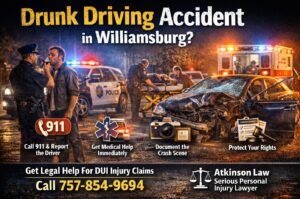
After a suspected drunk driving accident in Williamsburg, call 911, address immediate medical needs, preserve available evidence and notify the appropriate insurance companies. A DUI arrest or charge may support an injury claim, but it does not automatically establish civil liability or guarantee compensation.
The injured person must still establish that the other driver’s conduct caused the collision and resulting losses. The criminal DUI prosecution and civil injury claim are separate proceedings with different purposes, evidence and legal standards.
Important steps include:
- Call 911 and remain in a safe location.
- Obtain emergency medical assistance when needed.
- Cooperate with police without speculating about fault.
- Exchange driver, vehicle and insurance information.
- Photograph the vehicles, road and visible injuries.
- Identify witnesses and possible video sources.
- Notify your automobile insurer promptly.
- Preserve police, toxicology, criminal-court and insurance records.
- Document medical treatment, income loss and other expenses.
- Track the civil filing deadline independently from the criminal case.
A Williamsburg drunk driving accident lawyer can review the collision, criminal-case evidence, insurance coverage and potential damages. Legal representation does not guarantee compensation or punitive damages.
What to Do After a Williamsburg Drunk Driving Accident
| Priority | Recommended action |
|---|---|
| Immediate safety | Call 911, check for injuries and avoid standing in active traffic. |
| Medical care | Obtain emergency help for serious symptoms and report later-developing symptoms to a healthcare provider. |
| Police evidence | Record the officer, agency, report number and criminal charge information. |
| Scene evidence | Preserve photographs, video, witness information and nearby surveillance sources. |
| Insurance | Notify your insurer and identify liability, UM/UIM and other applicable coverage. |
| Deadlines | Do not assume the criminal prosecution or insurance claim extends the civil filing period. |
Get a free legal consultation
CALL 757-648-85791. Call 911 and Report the Collision
Call 911 when a collision may involve an impaired driver, injury, unsafe traffic conditions or significant vehicle damage.
Tell the dispatcher:
- The precise location
- The number of involved vehicles
- Whether anyone appears injured
- Whether traffic is blocked
- Whether a driver appears impaired
- Whether a driver is attempting to leave
- The direction of travel if a vehicle leaves
Do not follow or confront a driver who leaves the scene. Provide the vehicle description and license plate information to law enforcement.
What may police investigate?
Depending on the circumstances, officers may investigate:
- Driver appearance and behaviour
- Odour of alcohol
- Speech and coordination
- Field sobriety performance
- Preliminary breath-test information
- Evidential breath or blood results
- Drug impairment
- Witness statements
- Vehicle and roadway evidence
- Traffic-law violations
The police investigation may produce important evidence. It does not automatically decide civil liability.
2. Obtain Emergency Medical Care When Necessary
Call 911 or seek emergency care for symptoms such as:
- Loss of consciousness
- Difficulty breathing
- Serious bleeding
- Severe neck, back, chest or abdominal pain
- Weakness, numbness or reduced coordination
- A worsening headache
- Repeated vomiting
- Seizure
- Slurred speech
- Increasing confusion
- One pupil larger than the other
- Increasing drowsiness or difficulty waking
Some injuries and concussion symptoms may appear hours or days after the collision. Contact a qualified healthcare professional when symptoms develop, persist or worsen.
Describe the collision accurately
Tell the healthcare provider:
- How the collision occurred
- Which part of the vehicle was struck
- Whether the airbag deployed
- Whether your head or body struck another surface
- Whether you lost consciousness
- Every symptom you are experiencing
- Relevant prior injuries and medical conditions
Medical decisions should be based on health needs and professional advice—not on an effort to increase the value of a legal claim.
Serious neurological injuries may require guidance from a Williamsburg brain injury lawyer or a Williamsburg spinal cord injury lawyer.
Contact our personal injury lawyers today
GET FREE EVALUATION3. Move to Safety and Preserve the Scene
Do not remain in an active traffic lane solely to collect evidence.
When safe and legally appropriate:
- Activate the vehicle’s hazard lights.
- Move to the shoulder or a nearby safe location.
- Follow police and emergency instructions.
- Avoid standing between damaged vehicles.
- Do not touch open containers or suspected drugs.
Tell police where the vehicles were located before they were moved.
4. Exchange Driver and Insurance Information
Obtain:
- The driver’s full name and contact information
- Driver’s license information
- Vehicle registration
- License plate number
- Insurance company and policy information
- The vehicle owner’s information when different from the driver
Avoid arguing about intoxication or fault. Do not attempt to conduct your own sobriety test or physically detain the driver.
5. Photograph and Record Available Evidence
When physically able and safely positioned, photograph:
- All sides of the involved vehicles
- Interior damage
- Airbag deployment
- License plates
- Skid marks and debris
- Traffic lights and signs
- Road and weather conditions
- Visible injuries
- Open containers visible without entering another person’s vehicle
- The wider scene from several directions
Preserve original files without filters or edits.
Do not create unnecessary confrontation
Do not place a phone directly in another person’s face, enter another vehicle or interfere with the police investigation.
Lawful video showing driving behaviour, speech, balance or statements may become relevant, but personal safety takes priority.
6. Identify Witnesses and Video Sources
Obtain each witness’s name, telephone number and email address.
Potential video sources include:
- Dash cameras
- Business surveillance systems
- Doorbell cameras
- Hotels and parking facilities
- Rideshare or commercial vehicles
- Traffic-management systems
- Police body and dashboard cameras
Some systems overwrite recordings quickly. Record the location and ownership of each potential camera.
7. Notify Your Automobile Insurer
Provide prompt, accurate notice in accordance with your policy.
Initial information may include:
- The date, time and location
- The involved vehicles and drivers
- The police agency and report number
- Whether injuries were reported
- Where the vehicle was towed
Do not guess about:
- The exact BAC
- Whether the driver will be convicted
- Vehicle speed
- Medical diagnosis
- Whether an injury is permanent
- The value of the claim
Should you give a recorded statement?
There is no universal rule that every statement should be refused.
Before participating, ask:
- Which insurer is requesting the statement?
- Whom does the insurer represent?
- Which policy and claim number apply?
- Does your policy require cooperation?
- How will the recording be used?
- Will you receive a copy or transcript?
Your obligations to your own insurer may differ from your obligations to the other driver’s liability carrier.
8. Obtain the Police Report and DUI Case Information
Record:
- The police agency
- The investigating officer’s name
- The report or incident number
- The driver’s full legal name
- The criminal or traffic charges
- The court handling the charge
- Future hearing dates, when publicly available
The crash report may not contain every item of DUI evidence. Breath certificates, blood results, search warrants, body-camera footage and court records may be maintained separately.
Does a DUI Charge Prove the Civil Case?
No. A DUI charge is an allegation in a criminal case.
A civil claim must separately establish:
- The driver owed a duty of reasonable care.
- The driver breached that duty.
- The breach caused the collision.
- The collision caused the claimed injuries and losses.
Intoxication may support breach and punitive-damages arguments, but it does not eliminate the need to prove causation and damages.
What if the driver pleads guilty or is convicted?
Virginia law may permit evidence of a guilty or no-contest plea, a finding of guilt in absentia or a forfeiture arising from the same occurrence to be admitted in the civil action.
The civil court must still evaluate the legal significance of that evidence.
What if the DUI charge is dismissed?
Dismissal or acquittal does not necessarily decide the civil claim. Criminal guilt generally requires proof beyond a reasonable doubt, while civil issues use different legal standards.
The civil claim may rely on crash evidence, witness testimony and proof of negligent driving even when a DUI conviction does not result.
What Is the Difference Between DUI and DWI in Virginia?
Virginia statutes prohibit driving or operating a motor vehicle while:
- The driver has a qualifying BAC of at least 0.08%;
- The driver is under the influence of alcohol;
- The driver is impaired by drugs or another intoxicant;
- The driver is impaired by a combination of alcohol and drugs; or
- Certain specified drugs are present at or above statutory blood-concentration levels.
The terms DUI and DWI are often used interchangeably in general discussion of Virginia impaired-driving cases.
Can an Injured Person Recover Punitive Damages?
Potentially, but punitive damages are not automatic.
Under Virginia Code § 8.01-44.5, punitive damages may be considered when the evidence establishes malice or conduct so willful or wanton that it demonstrated conscious disregard for others’ rights.
The statute establishes one route when:
- The driver’s BAC was at least 0.15% at the time of the incident;
- The driver knew or should have known that alcohol impaired or would impair driving ability; and
- The intoxication proximately caused the injury or death.
The statute also addresses an unreasonable refusal to submit to a required BAC test when other evidence establishes intoxication, knowledge and causation.
Virginia limits the total punitive-damages award against all defendants to $350,000.
Does a BAC between 0.08% and 0.14% prevent punitive damages?
Not necessarily. It may prevent reliance on the statute’s automatic 0.15% route, but other evidence may still be evaluated under the broader willful-and-wanton standard.
No particular award is guaranteed.
How Can Contributory Negligence Affect the Claim?
Virginia generally follows contributory negligence in ordinary negligence cases.
A defendant may allege that the injured person:
- Was speeding
- Failed to yield
- Entered against a traffic signal
- Was distracted
- Made an unsafe lane change
- Failed to maintain a proper lookout
The other driver’s intoxication does not automatically prevent these arguments.
An allegation is not proof. The defendant must support the alleged negligence and establish that it proximately contributed to the collision.
Learn more about Virginia contributory negligence.
Who May Be Responsible?
The impaired driver
The driver may be responsible when impaired or otherwise negligent operation caused the collision.
The vehicle owner
A separate claim may require investigation when someone knowingly entrusted a vehicle to a person who was unfit to drive.
Vehicle ownership alone does not automatically establish independent negligence.
An employer
An employer may require investigation when the impaired driver was acting within the scope of employment. Separate negligent hiring, supervision or entrustment theories require their own supporting evidence.
Another driver
A collision may involve concurrent negligence by more than one motorist.
A bar, restaurant or social host
Virginia generally does not recognise an ordinary dram-shop claim against an alcohol vendor merely because it served a customer who later caused a collision.
A business or another person should not be named as responsible without a recognised independent legal duty and supporting evidence.
What Insurance May Apply?
Potential insurance sources include:
- The impaired driver’s liability policy
- The vehicle owner’s policy
- Commercial or employer coverage
- Umbrella or excess liability insurance
- The injured person’s uninsured motorist coverage
- The injured person’s underinsured motorist coverage
- Optional medical-expense benefits
- Another responsible driver’s policy
A policy limit does not establish the claim’s value or guarantee payment of the limit.
What if the driver has insufficient insurance?
Underinsured motorist coverage may become relevant when the supported damages exceed the available liability coverage, subject to the policy and Virginia law.
Review all policies covering the injured person, vehicle and household before concluding that only one source is available.
What Compensation May Be Available?
When liability, causation and damages are established, potential compensatory damages may include:
- Emergency treatment
- Past medical expenses
- Reasonably anticipated future medical care
- Rehabilitation
- Medication
- Lost income
- Reduced earning capacity
- Physical pain and inconvenience
- Emotional effects
- Scarring and disfigurement
- Permanent impairment
- Vehicle and personal-property damage
- Other losses recoverable under Virginia law
Punitive damages require a separate legal showing and serve a purpose different from compensatory damages.
How Should Medical and Financial Losses Be Documented?
Preserve:
- Medical records and itemised bills
- Prescription receipts
- Therapy records
- Written work restrictions
- Pay statements and tax records
- Employer verification
- Repair estimates
- Towing and storage charges
- Rental-car expenses
- Receipts for accident-related costs
A brief symptom and activity record may help describe changes over time, provided that it remains accurate and is not exaggerated.
What if the Drunk Driving Accident Was Fatal?
A Virginia wrongful death action may exist when impaired or negligent driving caused the person’s death.
The action generally must be brought by the deceased person’s properly appointed personal representative.
Potential wrongful death damages may include:
- Sorrow, mental anguish and solace
- Loss of expected income
- Loss of services, protection, care and assistance
- Final medical and hospital expenses
- Reasonable funeral expenses
- Punitive damages when the applicable standard is established
Learn more about working with a Williamsburg wrongful death lawyer.
How Long Do You Have to File?
Under Virginia Code § 8.01-243:
- A personal injury action generally must be filed within two years after accrual.
- A property-damage action generally must be filed within five years after accrual.
A Virginia wrongful death action generally must be filed by the personal representative within two years after death.
Different deadlines or requirements may apply when:
- The injured person is a minor or incapacitated person.
- A government vehicle or agency is involved.
- The responsible driver cannot be identified.
- A previous action was dismissed or nonsuited.
- Another statute controls.
The DUI prosecution, insurance investigation and settlement negotiations do not necessarily pause the civil filing period.
Should You Accept an Early Settlement?
An early settlement is not automatically unfair. It may be premature when:
- The diagnosis remains uncertain.
- Treatment is continuing.
- Future care may be required.
- The person has not returned to work.
- The BAC or criminal evidence remains unavailable.
- Additional insurance may apply.
- Punitive damages have not been evaluated.
- Medical liens remain unresolved.
A signed release may permanently end the claims described in the document.
What Can a Drunk Driving Accident Lawyer Do?
Depending on the case, a lawyer may:
- Investigate the collision
- Preserve video and physical evidence
- Obtain police and criminal-court records
- Request available breath or blood evidence
- Identify insurance policies
- Evaluate contributory-negligence allegations
- Document medical and income losses
- Evaluate potential punitive damages
- Negotiate a settlement
- File and litigate a lawsuit when appropriate
A lawyer cannot guarantee a DUI conviction, civil recovery, punitive damages or a particular settlement amount.
Frequently Asked Questions
Does a DUI arrest prove the other driver caused the crash?
No. It may be important evidence, but the civil claim must still establish negligent conduct, causation and damages.
Does the driver need a BAC of 0.08% to be charged?
Not always. Virginia also prohibits driving while impaired by alcohol, drugs or a combination of substances.
Are punitive damages automatic?
No. The claimant must satisfy Virginia’s statutory or general willful-and-wanton standard.
What BAC supports Virginia’s statutory punitive-damages route?
The statute identifies a BAC of at least 0.15%, together with the required knowledge and causation evidence.
What if the driver refused a blood or breath test?
Virginia’s punitive-damages statute contains a separate route involving an unreasonable refusal when intoxication, knowledge and causation are otherwise established.
Can the driver’s guilty plea be used in the civil case?
Potentially. Virginia law permits certain guilty or no-contest pleas, findings and forfeitures arising from the same occurrence to be admitted in a civil action.
Can I sue the bar that served the driver?
Virginia generally does not recognise an ordinary dram-shop claim against a vendor solely for providing alcohol to a patron who later causes a collision.
What if the driver has minimal insurance?
Review the vehicle owner’s policy, UM/UIM protection, commercial coverage, umbrella policies and other potentially applicable insurance.
Does the criminal case extend the civil deadline?
Not necessarily. The civil filing period should be tracked independently.
Does hiring a lawyer guarantee compensation?
No. The outcome depends on liability, causation, injuries, evidence, insurance, legal defenses and collectability.
Discuss a Williamsburg Drunk Driving Accident With Atkinson Law
A drunk driving collision may involve a criminal prosecution, civil-liability investigation, toxicology evidence, punitive-damages issues and several insurance policies.
Atkinson Law can review:
- The collision and police investigation
- Available DUI and court evidence
- Medical and financial losses
- Insurance coverage
- Potential contributory negligence
- Punitive-damages requirements
- Applicable filing deadlines
Learn more about working with a Williamsburg car accident lawyer.
Call or text 757-648-8579 or contact Atkinson Law to request a free, no-obligation consultation.
This page provides general legal, medical and insurance information. A DUI arrest or charge does not establish civil liability, and no result is guaranteed. Every claim depends on the evidence, injuries, insurance, applicable law and defenses. Call 911 for emergencies and obtain advice from a qualified healthcare professional concerning injuries. Reading this page or contacting the firm does not create an attorney-client relationship.
Call or text 757-648-8579 or complete a Free Case Evaluation form
CONTACT US TODAY
