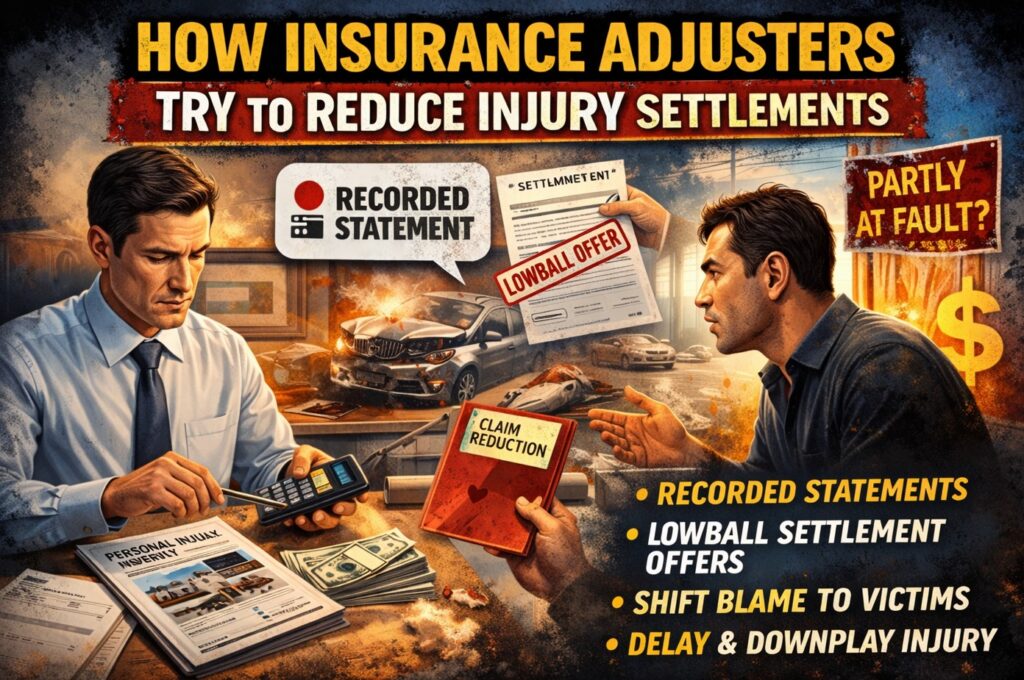
Insurance adjusters investigate coverage, liability, causation and damages on behalf of insurance companies. Their evaluation may result in a reduced settlement offer when they dispute who caused the accident, whether the accident caused the injury, whether treatment was reasonable or whether the claimed losses are adequately documented.
A low offer or request for additional information is not automatically improper. However, an injured person should understand how statements, medical authorizations, treatment records, releases and Virginia’s contributory-negligence rule may affect the claim.
A personal injury lawyer serving Richmond can review insurer communications and explain which requests may be required, reasonable, overbroad or potentially harmful. Representation does not guarantee a settlement or a particular result.
Insurance Claim Issues at a Glance
| Claim issue | Why an offer may be reduced | How the claimant may respond |
|---|---|---|
| Recorded statement | The insurer identifies inconsistent, incomplete or speculative answers | Determine who is requesting it, whether cooperation is required and which issues will be discussed |
| Early settlement offer | Treatment and future losses have not yet been fully documented | Review the prognosis, coverage and release terms before accepting |
| Contributory negligence | The insurer alleges that the claimant helped cause the accident | Preserve scene evidence, witnesses, video and vehicle information |
| Pre-existing condition | The insurer disputes whether the accident caused the symptoms | Use medical evidence to document the prior baseline and post-accident change |
| Treatment gap | The insurer questions the seriousness or continuity of the condition | Document the medical or practical reason for the interruption |
| Lost income | Employment or medical documentation is incomplete | Obtain restrictions, payroll records, tax documents and employer verification |
| Policy limit | Available coverage may be less than the supported damages | Investigate vehicle-owner, employer, umbrella and UM/UIM policies |
| Claim delay | The insurer states that more evidence or investigation is required | Request a written status, identify missing items and continue tracking the filing deadline |
Get a free legal consultation
CALL 757-648-8579What Does an Insurance Adjuster Do?
An adjuster may investigate:
- Whether the insurance policy covers the incident
- Who caused the accident
- Whether the claimant contributed to the accident
- Whether the accident caused the claimed injury
- Whether treatment was related and medically supported
- Past and future medical expenses
- Income loss
- Property damage
- Policy limits
- Other available insurance
The adjuster may interview witnesses, review photographs and video, inspect vehicles, request records and consult medical, engineering or other professionals.
The adjuster works for the insurance company. The adjuster is not the injured claimant’s attorney, doctor or financial adviser.
Which Insurance Company Is Contacting You?
Before responding, identify the adjuster’s role.
Your own insurance company
Your policy may require prompt notice, reasonable cooperation, document production, a statement or a physical examination under specified circumstances.
Failing to satisfy a valid policy condition may create a coverage dispute. The scope of any requirement depends on the policy and applicable law.
The other driver’s insurance company
The liability carrier investigates whether its insured is legally responsible. It may request a statement, records, photographs or proof of damages.
The claimant generally does not have the same contractual relationship with the other driver’s carrier that exists with the claimant’s own insurer.
Your uninsured or underinsured motorist carrier
A UM/UIM claim is made under the claimant’s own policy, but the insurer may dispute:
- The other driver’s liability
- Contributory negligence
- Medical causation
- The amount of damages
- Which policy has priority
- Whether the tortfeasor was uninsured or underinsured
Do not assume that a first-party relationship eliminates every disagreement.
Contact our personal injury lawyers today
GET FREE EVALUATION1. Requesting an Early Recorded Statement
An adjuster may ask for a recorded account before the claimant has received the police report, reviewed photographs or understood the full extent of the injuries.
Potential problems include:
- Guessing about speed, distance or timing
- Giving an incomplete description of symptoms
- Failing to remember a relevant detail
- Using casual wording that is later interpreted literally
- Agreeing that the person feels “fine” before delayed symptoms develop
- Minimizing prior medical conditions
Should every recorded statement be refused?
No. The correct response depends on which insurer is requesting the statement and whether the claimant has a contractual obligation to cooperate.
Before participating, ask:
- Who does the adjuster represent?
- What policy applies?
- Is the statement required by a policy condition?
- Which subjects will be covered?
- Will a copy or transcript be provided?
- Can the statement be scheduled after relevant records are available?
Any statement should be truthful. The claimant should not guess, exaggerate or intentionally omit important prior medical information.
2. Requesting a Broad Medical Authorization
Medical records may be necessary to establish diagnosis, causation, treatment and prognosis.
However, an authorization may be written broadly enough to cover:
- Many years of records
- Every prior provider
- Unrelated treatment
- Mental-health information
- Substance-use information
- Prescription history
- Records created after the claim ends
Review the requested date range, providers, information categories, expiration date and redisclosure terms.
A claimant may sometimes provide relevant records directly or use a more targeted authorization. Whether that approach satisfies a first-party policy obligation depends on the policy and circumstances.
3. Offering a Quick Settlement
An early settlement can provide certainty and immediate payment. It may also arrive before the claimant knows:
- The final diagnosis
- Whether surgery will be needed
- How long symptoms will continue
- Whether the person can return to the same work
- Whether permanent restrictions will remain
- Whether another policy applies
- The amount of medical liens or reimbursement claims
An early offer is not automatically unfair. The concern is whether the claimant has enough reliable information to evaluate the release.
What does a release do?
A release generally gives up the claims described in the document in exchange for payment.
Review whether it releases:
- The negligent person
- The vehicle owner
- An employer
- Other drivers
- Unknown parties
- Property-damage claims
- Future medical claims
- UM/UIM claims
Do not assume that a document releases only the insurer presenting it.
Can an early release be cancelled?
Under Virginia Code § 8.01-425.1, an unrepresented claimant who signs a personal-injury release within 30 days after the incident may have a limited right to rescind.
The claimant generally must:
- Rescind by midnight of the third business day after signing;
- Provide the rescission in writing; and
- Return any check or settlement proceeds already received.
This is a narrow protection. It should not be treated as a general right to cancel every settlement.
4. Alleging Contributory Negligence
Virginia generally follows contributory negligence in ordinary negligence cases.
An insurer may allege that the claimant:
- Was speeding
- Failed to yield
- Entered against a traffic signal
- Made an unsafe lane change
- Followed too closely
- Was distracted
- Failed to maintain a proper lookout
The shorthand phrase “even 1% at fault” can be misleading. Virginia does not ordinarily ask a jury to assign comparative percentages.
The defense generally requires evidence that the claimant failed to use reasonable care and that this failure proximately contributed to the accident or injury.
An adjuster’s assertion does not decide the legal issue.
Learn more about how contributory negligence may affect a Virginia injury claim.
5. Arguing That the Injury Was Pre-Existing
A prior medical condition may affect causation and damages, but it does not automatically eliminate the claim.
The relevant questions may include:
- What symptoms existed before the accident?
- Was the person actively receiving treatment?
- Had the condition stabilized?
- Did the accident create a new injury?
- Did it aggravate or accelerate an existing condition?
- Which treatment would have occurred without the accident?
Useful evidence may include:
- Pre-accident records
- Post-accident diagnostic tests
- Treating-provider opinions
- Employment records
- Statements from people familiar with the claimant’s prior abilities
Hiding a prior condition can damage credibility. The stronger approach is an accurate explanation of how the person’s condition changed.
6. Using a Gap or Delay in Treatment
An insurer may argue that a substantial gap means:
- The injury was not serious;
- The condition resolved;
- Later treatment resulted from another cause; or
- The claimant failed to follow medical advice.
A gap may have a legitimate explanation, including:
- Difficulty obtaining a specialist appointment
- Transportation problems
- Insurance or authorization issues
- Physician instructions to wait
- Temporary improvement
- Work or family obligations
Report persistent or worsening symptoms to an appropriate healthcare professional. Treatment decisions should be based on medical needs, not an effort to increase a settlement.
7. Using Limited Vehicle Damage to Dispute Injury
An adjuster may compare repair estimates and photographs with the claimed injury.
Vehicle damage can be relevant, but it does not independently determine medical causation.
A complete review may include:
- Direction and angle of impact
- Vehicle weight and structure
- Occupant position
- Seat and restraint performance
- Prior medical vulnerability
- Diagnostic findings
- Biomechanical or medical evidence when appropriate
Neither “minor damage means no injury” nor “every minor impact causes serious injury” is a reliable universal rule.
8. Disputing Lost Income or Earning Capacity
An insurer may reduce or reject an income-loss claim when documentation is incomplete.
Potential evidence includes:
- Written medical restrictions
- Employer verification
- Pay statements
- Tax returns
- Attendance records
- Commission or bonus history
- Self-employment records
- Evidence of lost opportunities
Future earning-capacity claims may require vocational, medical or economic evidence. A claimant’s estimate alone may not be enough.
9. Reviewing Social Media and Public Information
Adjusters and defense representatives may review publicly available:
- Photographs
- Videos
- Comments
- Location information
- Work activity
- Travel and recreation
A short photograph or video may lack medical context, but it may still be compared with statements about limitations.
Do not:
- Delete relevant evidence after a dispute begins;
- Post inaccurate descriptions of the accident;
- Exaggerate symptoms;
- Discuss settlement negotiations publicly; or
- Ask another person to hide evidence.
10. Requesting Additional Documents or Taking More Time
An insurer may need additional time to investigate:
- Coverage
- Conflicting witness accounts
- Medical causation
- Future treatment
- Employment losses
- Other insurance
- Multiple claimants
Repeated or unexplained requests may nevertheless delay evaluation.
Ask the adjuster to identify in writing:
- Which documents remain missing;
- Why they are relevant;
- Whether coverage has been accepted or denied;
- Which liability issues remain disputed; and
- When the next review is expected.
What Virginia Claim-Handling Standards Apply?
Virginia Code § 38.2-510 identifies unfair claim-settlement practices that may include:
- Misrepresenting pertinent facts or policy provisions;
- Failing to respond reasonably promptly;
- Failing to maintain reasonable investigation standards;
- Arbitrarily and unreasonably refusing payment;
- Failing to affirm or deny coverage within a reasonable time; and
- Failing to attempt a prompt, fair and equitable settlement when liability has become reasonably clear.
The statute generally addresses conduct performed frequently enough to indicate a general business practice. One disputed offer does not necessarily establish a violation.
Should a claim denial be in writing?
Virginia insurance regulations generally require a written denial and a reasonable explanation. When relevant, the explanation should identify the policy provision, condition or exclusion supporting the decision.
Keep:
- The denial letter
- The policy and declarations pages
- Emails and portal messages
- Claim numbers
- Adjuster names
- A dated communication log
Can You File an Insurance Complaint?
A person experiencing an insurance problem may use the Virginia State Corporation Commission Bureau of Insurance complaint process.
A complaint may be appropriate when the concern involves:
- Unexplained delay
- Failure to respond
- Misrepresentation of policy terms
- An unexplained coverage denial
- Failure to provide a written reason
- Another potential insurance-regulation issue
The SCC complaint process is separate from the personal injury claim. It does not automatically award compensation or extend the civil filing deadline.
Does a Low Offer Create a Bad-Faith Claim?
Not automatically.
Virginia Code § 8.01-66.1 provides specific remedies involving certain motor-vehicle claims by insured persons, including qualifying disputes over:
- Property-damage benefits
- Medical-expense benefits
- Loss-of-income benefits
- Uninsured motorist benefits
- Underinsured motorist benefits
The statute contains detailed procedural and notice requirements. It is not a general bad-faith remedy against the other driver’s insurance company whenever the parties disagree about claim value.
What Is a Settlement Actually Worth to the Claimant?
Distinguish the gross settlement from the net amount ultimately received.
Possible deductions or obligations include:
- Attorney fees
- Case expenses
- Medical-provider liens
- Medicare or Medicaid interests
- Government-benefit liens
- Outstanding treatment balances
- Other valid reimbursement obligations
A lower gross offer is not the only issue. The claimant should also understand how outstanding obligations affect the final distribution.
How Can an Injured Person Protect the Claim?
- Identify the adjuster. Determine which insurer and policy the person represents.
- Report the claim accurately. Provide required notice without guessing about unresolved facts.
- Preserve the scene evidence. Keep photographs, video, witness information and vehicle records.
- Follow appropriate medical advice. Report persistent symptoms and explain treatment interruptions accurately.
- Review medical authorizations. Understand the providers, period and information being requested.
- Document income loss. Obtain restrictions, employer verification and financial records.
- Request written decisions. Ask for the factual and policy basis of any denial or reduction.
- Review every release. Identify all people, companies, claims and insurance rights being released.
- Investigate all coverage. Do not assume one liability policy is the only potential source.
- Track the filing deadline. Do not allow settlement discussions to replace timely legal action.
How Long Do You Have to File?
Under Virginia Code § 8.01-243:
- A personal injury action generally must be filed within two years after accrual.
- A property-damage action generally must be filed within five years after accrual.
Different rules may apply when:
- The claimant is a minor or incapacitated person;
- A government entity may be responsible;
- A defendant cannot initially be identified;
- A previous action was dismissed or nonsuited; or
- Another statute controls.
Insurance negotiations, requests for additional records and regulatory complaints do not necessarily extend the filing period.
Frequently Asked Questions
Is an insurance adjuster allowed to offer less than I demand?
Yes. A settlement is a negotiated compromise, and the insurer may dispute liability, causation, treatment or damages. A low offer alone does not establish unlawful conduct.
Do I have to give a recorded statement?
It depends on which insurer is asking and whether a valid policy condition requires cooperation. Obligations to your own insurer may differ from those involving the other party’s insurer.
Should I sign the insurer’s medical authorization?
Review its scope first. Relevant medical records may be necessary, but a broad authorization may cover unrelated providers, conditions and time periods.
Can the insurer deny my claim because I had a prior injury?
A prior condition may affect causation and damages, but it does not automatically eliminate a claim for a new injury or supported aggravation.
Does a treatment gap end the claim?
No. It may create a causation dispute, but the reason for the gap and the medical evidence must be evaluated.
Does minor vehicle damage mean I was not injured?
Not necessarily. Vehicle damage may be relevant, but medical causation depends on the collision mechanics, individual condition and medical evidence.
Can an adjuster use my social-media posts?
Publicly available material may be reviewed and compared with statements about the accident and limitations.
Can I cancel a settlement after signing the release?
Virginia provides a limited three-business-day rescission right for certain unrepresented claimants who sign within 30 days after the incident. Other releases may be binding once signed.
Does filing an SCC complaint stop the statute of limitations?
Not necessarily. The regulatory complaint and civil filing deadline should be treated separately.
Does hiring a lawyer guarantee a higher settlement?
No. The result depends on liability, causation, injuries, documentation, insurance, defenses and collectability.
Discuss an Insurance Claim With Atkinson Law
An injury claim may involve recorded statements, medical authorizations, contributory negligence, pre-existing conditions, multiple insurance policies, releases and strict filing deadlines.
Atkinson Law serves injured people in Richmond and can review:
- The accident and liability evidence
- Insurer correspondence
- Recorded-statement requests
- Medical and income documentation
- Settlement offers and releases
- Liability, UM/UIM and other coverage
- Potential liens and reimbursement obligations
- Virginia filing deadlines
Learn more about a Richmond car accident claim or working with a personal injury lawyer serving Richmond.
Call or text 757-648-8579 or contact Atkinson Law to request a consultation.
Call or text 757-648-8579 or complete a Free Case Evaluation form
CONTACT US TODAY