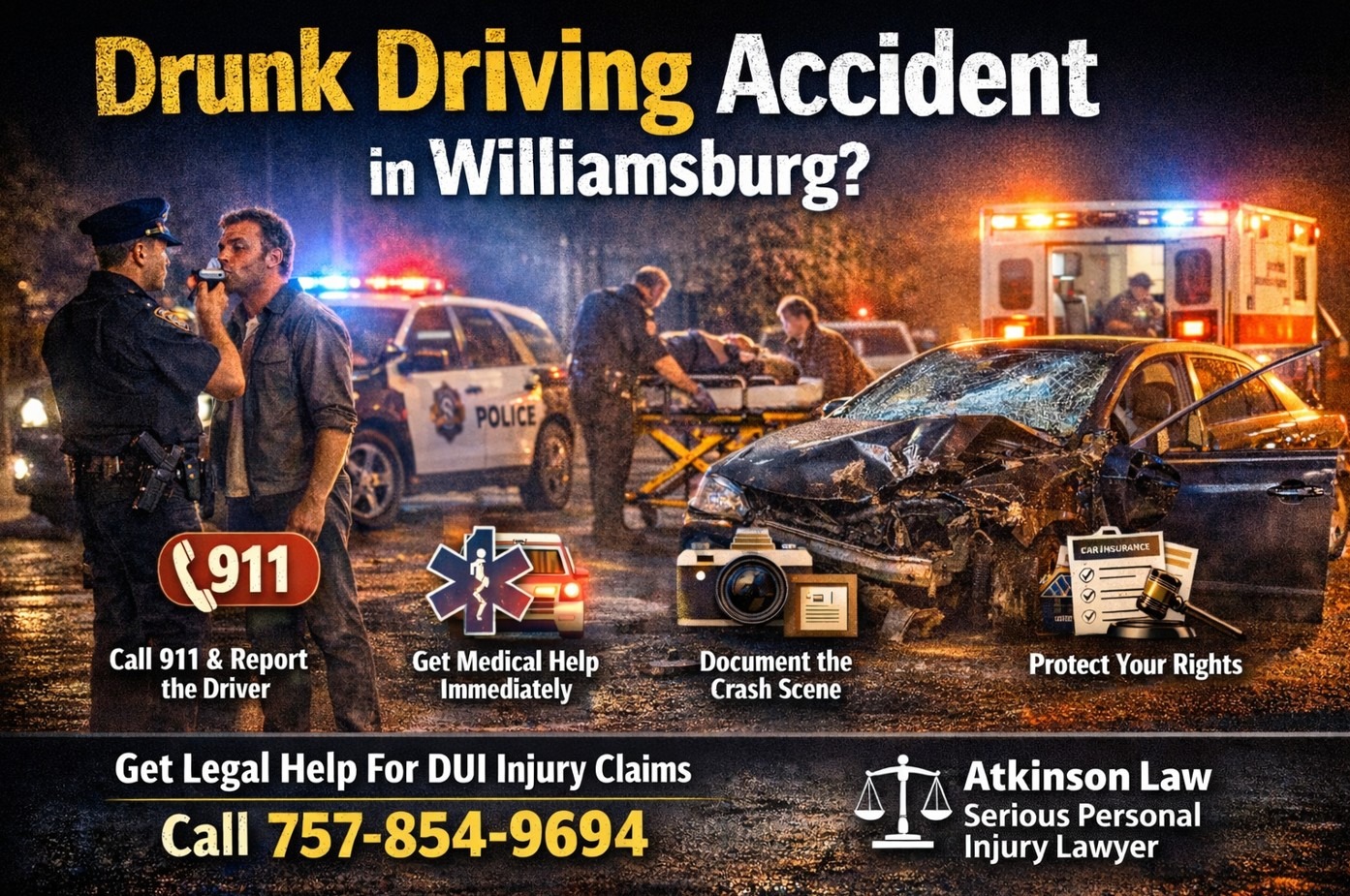

A fatal drunk driving accident may support a Virginia wrongful death claim when the impaired driver’s wrongful conduct caused the collision and death. A DUI arrest, charge or elevated blood alcohol result may provide important evidence, but it does not automatically prove every element of the civil claim or guarantee punitive damages.
The wrongful death action generally must be filed by the deceased person’s properly appointed personal representative for the benefit of the statutory beneficiaries identified by Virginia law.
A wrongful death lawyer serving Richmond can review the collision, criminal-case evidence, insurance coverage, family relationships, economic losses and applicable filing deadline.
Fatal DUI Wrongful Death Claims at a Glance
| Question | General Virginia rule |
|---|---|
| Who files the claim? | The decedent’s properly appointed personal representative generally files the action. |
| Who may receive compensation? | Virginia’s statutory beneficiaries, according to the priority system established by law. |
| Does a DUI charge prove liability? | No. The civil claim must still establish wrongful conduct, causation and damages. |
| Are punitive damages automatic? | No. They require evidence satisfying Virginia’s statutory or general willful-and-wanton standard. |
| How long is the deadline? | A Virginia wrongful death action generally must be filed within two years after death. |
| Does a settlement need approval? | Virginia wrongful death settlements generally require circuit-court approval. |
Get a free legal consultation
CALL 757-648-8579What Is a Virginia Wrongful Death Claim?
Under Virginia Code § 8.01-50, a wrongful death claim may exist when:
- A person or company committed a wrongful act, neglect or default;
- That conduct caused the person’s death; and
- The deceased person could have pursued a legal claim had death not occurred.
A fatal result alone does not establish liability. The personal representative must prove that the defendant’s wrongful conduct caused the collision and death.
How Is the Civil Claim Different From the DUI Prosecution?
The criminal and civil proceedings are separate.
| Criminal DUI case | Wrongful death claim |
|---|---|
| Brought by the Commonwealth | Brought by the personal representative |
| Seeks criminal punishment | Seeks compensation and other civil relief |
| Requires proof beyond a reasonable doubt | Uses the applicable civil burden of proof |
| May result in conviction, fines or incarceration | May result in settlement, judgment or dismissal |
| Controlled by the prosecutor | Managed by the personal representative with legal counsel |
The family does not control whether the Commonwealth prosecutes or what criminal charge is pursued.
The wrongful death case should not be allowed to miss its civil deadline merely because the criminal prosecution remains pending.
Contact our personal injury lawyers today
GET FREE EVALUATIONDoes a DUI Arrest or Charge Prove the Wrongful Death Case?
No. An arrest or charge is an allegation, not a final civil finding.
Potential civil evidence may include:
- Police observations
- Breath or blood-test certificates
- Body-camera and dashboard-camera footage
- Field sobriety evidence
- Witness statements
- Vehicle event data
- Crash reconstruction
- A guilty or no-contest plea
- A criminal-court finding
Virginia law may permit certain pleas, findings of guilt and forfeitures arising from the same occurrence to be admitted in the civil action.
The personal representative must still establish that the impaired or otherwise negligent driving caused the crash and the decedent’s death.
Who Files the Wrongful Death Claim?
The lawsuit generally must be filed by the deceased person’s properly appointed personal representative.
The personal representative may be:
- An executor named in the decedent’s will;
- An administrator appointed when no executor qualifies; or
- Another person properly qualified through the appropriate circuit court.
A spouse, child, parent or other relative does not ordinarily file solely because of the family relationship. That person may first need to qualify as the personal representative or have another qualified person bring the action.
Who May Receive Wrongful Death Compensation?
Virginia law establishes classes of statutory beneficiaries.
Depending on the family structure, potential beneficiaries may include:
- A surviving spouse
- Children of the deceased
- Children of a deceased child
- Qualifying parents
- Brothers and sisters
- Certain relatives who depended primarily on the decedent and lived in the same household
The statutory order is detailed. Not every surviving relative automatically qualifies or receives an equal share.
The personal representative manages the claim but does not ordinarily keep the recovery personally unless also eligible as a beneficiary.
What Damages May Be Available?
Under Virginia Code § 8.01-52, wrongful death damages may include the following.
Sorrow, mental anguish and solace
Solace may include the loss of:
- Society
- Companionship
- Comfort
- Guidance
- Advice
- Family support
Loss of expected income
The claim may include income the decedent was reasonably expected to earn and contribute.
Relevant evidence may include:
- Employment records
- Tax returns
- Benefits
- Work history
- Expected career progression
- Retirement information
Loss of services, protection, care and assistance
A decedent may have provided valuable services even without current employment.
Examples include:
- Childcare
- Household work
- Transportation
- Caregiving
- Financial management
- Home maintenance
- Support for dependent relatives
Final medical expenses
The claim may include reasonable expenses for care, treatment and hospitalization resulting from the fatal injuries.
Funeral expenses
Reasonable funeral, burial or cremation expenses may be recoverable.
Punitive damages
Punitive damages may be considered when the required willful, wanton or conscious-disregard standard is established.
They are not automatic merely because alcohol was involved.
When May Punitive Damages Be Available?
Under Virginia Code § 8.01-44.5, punitive damages may be awarded at the factfinder’s discretion when the evidence proves malice or conduct sufficiently willful or wanton to demonstrate conscious disregard for others.
The statute establishes a specific route when the evidence proves:
- The driver had a blood alcohol concentration of at least 0.15% when the fatal incident occurred;
- The driver knew or should have known that alcohol impaired or would impair the ability to drive; and
- The intoxication was a proximate cause of the death.
The statute also addresses unreasonable refusal to provide a required alcohol test when other evidence establishes intoxication, knowledge and causation.
Virginia limits the total punitive-damages award against all liable defendants to $350,000.
What if the BAC was below 0.15%?
A result below 0.15% may prevent reliance on that particular statutory route. It does not necessarily end every punitive-damages argument because other conduct may still require evaluation under Virginia’s broader willful-and-wanton standard.
No punitive award is guaranteed.
What Evidence Should Be Preserved?
Important evidence may be distributed among police, prosecutors, hospitals, laboratories, businesses, insurers and private witnesses.
Potential evidence includes:
- Police crash reports
- Body-camera and dashboard-camera footage
- 911 recordings
- Breath and blood-test certificates
- Department of Forensic Science records
- Search warrants
- Criminal complaints and indictments
- Plea, conviction and sentencing records
- Witness statements
- Surveillance and dash-camera video
- Vehicle event-data-recorder information
- Cellphone and location evidence when legally obtainable
- Restaurant, bar or retail receipts
- Medical and autopsy records
- Employment and financial records
- Insurance policies
Some video and electronic records may be overwritten through ordinary retention practices. Prompt preservation requests may be appropriate.
Does the Family Need to Wait for the Criminal Case?
No. The civil investigation may proceed while the criminal prosecution remains pending.
Coordination may be necessary because:
- Some evidence may initially remain with law enforcement.
- The defendant may invoke constitutional rights.
- Criminal hearing dates may change.
- A plea or conviction may later become relevant.
- The two-year civil deadline continues to require attention.
The family should obtain the investigating agency, report number, defendant’s correct legal name, court handling the charges and publicly available hearing information.
Who May Be Legally Responsible?
The impaired driver
The driver may be responsible when intoxicated, reckless or otherwise negligent driving caused the collision.
The vehicle owner
A vehicle owner may require investigation when there is evidence of negligent entrustment or another independent basis for liability.
Ownership alone does not automatically make the owner responsible for the driver’s conduct.
An employer
An employer may require investigation when the driver was acting within the scope of employment.
Separate allegations involving hiring, supervision or entrustment need their own supporting evidence.
Another driver or entity
A fatal collision may involve negligence by more than one driver or another responsible person or company.
Each proposed defendant requires an independent legal and factual basis.
What Insurance May Apply?
Potential sources include:
- The intoxicated driver’s liability policy
- The vehicle owner’s policy
- Employer or commercial coverage
- Umbrella or excess insurance
- The decedent’s uninsured motorist coverage
- The decedent’s underinsured motorist coverage
- Other applicable household policies
A seriously injured or deceased person’s damages may exceed the driver’s liability limits.
For Virginia policies effective on or after January 1, 2025, the ordinary minimum liability limits are:
- $50,000 for bodily injury or death to one person;
- $100,000 for bodily injury or death to two or more people in one accident; and
- $25,000 for property damage.
Those figures are minimum limits. They do not determine wrongful-death value or guarantee payment of the full policy amount.
Can Contributory Negligence Affect a Fatal DUI Claim?
Potentially. Virginia generally follows contributory negligence in ordinary negligence cases.
A defendant may allege that the decedent:
- Was speeding
- Failed to yield
- Entered against a traffic signal
- Made an unsafe lane change
- Was distracted
- Failed to maintain a proper lookout
The intoxicated driver’s conduct does not make every defense disappear.
An allegation is not proof. The defendant must support the claimed negligence and connect it causally to the collision.
Learn more about Virginia contributory negligence.
How Is a Wrongful Death Recovery Distributed?
The recovery is generally paid to the personal representative.
The personal representative then:
- Pays court costs and reasonable attorney fees;
- Distributes amounts specifically allocated to qualifying medical and funeral expenses; and
- Distributes the remainder to the statutory beneficiaries according to the verdict, judgment or approved settlement.
The settlement amount should therefore be distinguished from the amount ultimately distributed to each beneficiary.
Does a Settlement Require Court Approval?
Yes. Virginia wrongful death settlements generally require approval by a circuit court, whether reached before or after filing the lawsuit.
The court process may address:
- The settlement amount and terms
- The statutory beneficiaries
- The proposed allocation
- Attorney fees and case expenses
- Medical and funeral expenses
- The interests of minor or incapacitated beneficiaries
The personal representative should not distribute a settlement informally without completing the required approval and allocation process.
How Long Does the Personal Representative Have to File?
Under Virginia Code § 8.01-244, a wrongful death action generally must be filed within two years after the injured person’s death.
Different calculations may apply when:
- A previous lawsuit was dismissed or nonsuited.
- A party dies during the proceedings.
- A defendant was initially unidentified.
- A government entity may be involved.
- Another tolling statute applies.
The criminal prosecution, insurance investigation and settlement negotiation do not necessarily pause the wrongful-death deadline.
What Should the Family Do After a Fatal DUI Crash?
- Obtain the police information. Record the agency, report number and investigating officer.
- Track the criminal case. Confirm the defendant’s legal name, charges and court information.
- Determine who will qualify as personal representative. The civil action generally cannot proceed properly without one.
- Preserve video and electronic evidence. Nearby cameras may overwrite recordings.
- Request relevant medical and autopsy records. Proper estate authority may be required.
- Identify every insurance policy. Do not assume the intoxicated driver’s policy is the only potential source.
- Preserve financial evidence. Keep employment, tax, benefit and household-service records.
- Document family relationships and dependency. These facts may affect beneficiary eligibility and damages.
- Avoid unsupported public accusations. Do not speculate about BAC, criminal guilt or additional defendants.
- Track the two-year deadline. Do not wait for the criminal case to end before reviewing the civil timeline.
Frequently Asked Questions
Does a DUI arrest guarantee a wrongful death claim?
No. The personal representative must still establish wrongful conduct, causation and damages.
Who files the lawsuit?
The deceased person’s properly appointed personal representative generally files the action.
Do all surviving relatives receive compensation?
No. Virginia uses statutory classes and priorities based on the decedent’s family and dependency relationships.
Are punitive damages automatic after a fatal drunk driving crash?
No. The evidence must satisfy Virginia’s statutory or general willful-and-wanton standard.
What BAC supports the statute’s specific punitive-damages route?
A BAC of at least 0.15%, together with the required knowledge and causation evidence.
What if the driver refused testing?
The statute provides a separate route when the refusal was unreasonable and intoxication, knowledge and causation are otherwise established.
Can a guilty plea be used in the civil case?
Potentially. Virginia law permits certain pleas, findings and forfeitures from the same occurrence to be admitted in the civil action.
Can the family settle without going to trial?
Potentially. Most disputed claims can be negotiated, but a Virginia wrongful death settlement generally requires circuit-court approval.
How long does the family have?
The personal representative generally must file the action within two years after death, subject to statutory provisions.
Does hiring a lawyer guarantee compensation?
No. The outcome depends on liability, causation, evidence, insurance, beneficiaries, defenses and applicable law.
Discuss a Fatal DUI Claim With Atkinson Law
A fatal drunk driving claim may involve criminal evidence, toxicology results, wrongful-death beneficiary rules, punitive damages, several insurance policies and court-supervised settlement distribution.
Atkinson Law serves families in Richmond and can review:
- The collision and police investigation
- The pending or completed criminal case
- Potential wrongful-death beneficiaries
- Medical, funeral and financial losses
- Liability and insurance evidence
- Punitive-damages requirements
- The filing deadline and settlement process
Learn more about working with a drunk driving accident lawyer serving Richmond or a wrongful death lawyer serving Richmond.
Call or text 757-648-8579 or contact Atkinson Law to request a free consultation.
Call or text 757-648-8579 or complete a Free Case Evaluation form
CONTACT US TODAY