
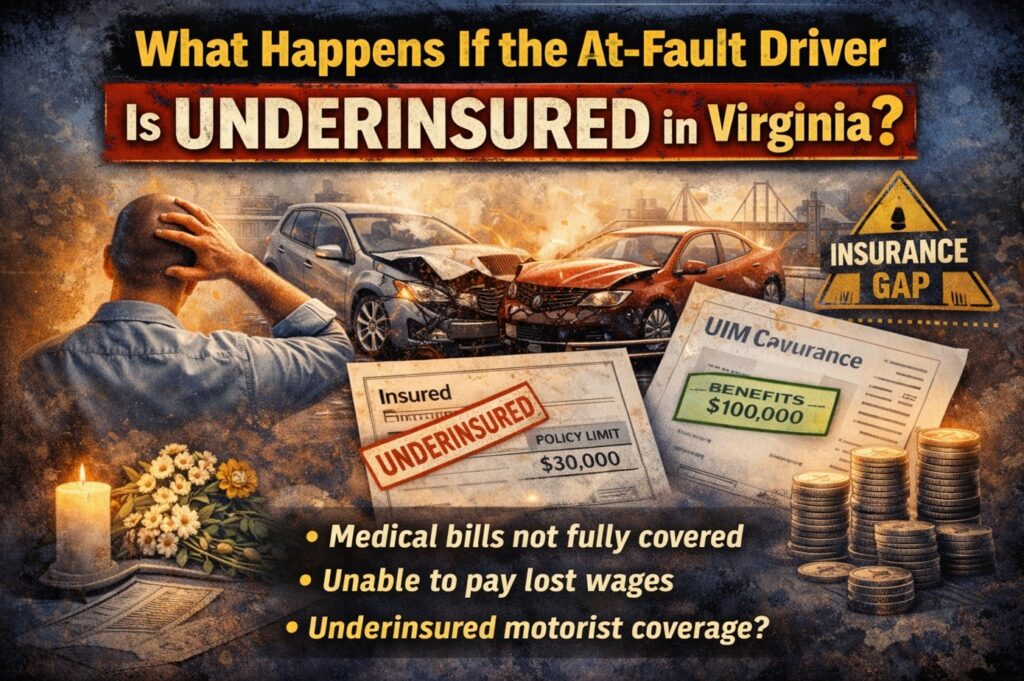
When an at-fault driver does not have enough liability insurance to cover the supported damages from a Virginia accident, one or more underinsured motorist policies may provide additional benefits.
Underinsured motorist coverage—commonly called UIM coverage—does not guarantee payment of every unpaid loss. The amount available may depend on:
- The injured person’s legally recoverable damages;
- The at-fault driver’s available liability coverage;
- The limits of each applicable UIM policy;
- Whether a named insured elected reduced UIM benefits;
- Which policy has priority;
- Whether several people are making claims;
- Liability and contributory-negligence evidence; and
- Compliance with settlement, notice and lawsuit procedures.
A car accident lawyer serving Richmond can review the policies, declarations pages, coverage elections and liability evidence. No insurance payment or result is guaranteed.
Underinsured Motorist Claims at a Glance
| Question | General Virginia rule |
|---|---|
| What does underinsured mean? | The responsible vehicle has liability insurance, but the available coverage is inadequate relative to the damages and applicable UIM coverage. |
| Is UIM required? | Virginia automobile policies generally include UM and UIM protection subject to statutory limits, elections and exceptions. |
| Does UIM always subtract the liability limits? | No. Current Virginia law generally provides add-on UIM unless a named insured signed an election allowing a liability-coverage credit. |
| Can several policies apply? | Potentially. Virginia establishes an order of priority among occupied-vehicle and other applicable policies. |
| Is a hit-and-run a UIM claim? | An unidentified driver is generally treated as uninsured, making the claim a UM matter rather than an underinsured claim. |
| Can the liability limits be accepted first? | Potentially. Virginia provides a statutory settlement procedure that can preserve a UIM claim when followed correctly. |
Get a free legal consultation
CALL 757-648-8579What Does “Underinsured” Mean in Virginia?
Under Virginia Code § 38.2-2206, a motor vehicle is underinsured when the total liability coverage applicable and available for payment is less than the injured person’s damages, up to the total UIM coverage available to that person.
This requires more than comparing two numbers on declarations pages.
The investigation should determine:
- The injured person’s supported damages;
- The at-fault driver’s per-person liability limit;
- The policy’s per-accident limit;
- Payments made or reserved for other injured people;
- Every applicable UIM limit; and
- Whether a reduction election applies.
What Are Virginia’s Minimum Liability Limits?
For Virginia automobile policies effective on or after January 1, 2025, the ordinary minimum liability limits are:
- $50,000 for bodily injury or death to one person;
- $100,000 for bodily injury or death to two or more people in one accident; and
- $25,000 for property damage.
A $50,000 bodily-injury limit may be inadequate when a collision causes surgery, extended hospitalization, permanent impairment, substantial income loss or death.
The minimum limit is not an automatic payment. Liability, causation and damages still must be established.
Contact our personal injury lawyers today
GET FREE EVALUATIONWhat Is Underinsured Motorist Coverage?
UIM coverage protects qualifying insured people when the responsible driver’s available liability insurance is insufficient.
Depending on the evidence and policy, UIM benefits may address:
- Past medical expenses;
- Reasonably anticipated future treatment;
- Lost income;
- Reduced earning capacity;
- Physical pain and inconvenience;
- Mental anguish;
- Scarring and disfigurement;
- Permanent impairment;
- Property damage; and
- Wrongful death damages recoverable under Virginia law.
The UIM insurer is not required to pay more than the supported damages or applicable coverage limits.
How Is UIM Different From UM Coverage?
| Uninsured motorist coverage | Underinsured motorist coverage |
|---|---|
| The responsible vehicle has no qualifying liability insurance. | The responsible vehicle has liability insurance, but the available amount is inadequate. |
| May apply when the liability insurer denies coverage. | Usually begins with identifying and evaluating the liability coverage. |
| May apply to an unknown hit-and-run driver. | Usually involves an identified driver and liability insurer. |
| May involve a John Doe action when the driver is unknown. | May continue in the name of an identified or statutorily released defendant. |
An unidentified hit-and-run driver is generally treated as uninsured rather than underinsured.
Does UIM Simply Fill the Remaining Gap?
Not necessarily. Virginia currently recognizes two possible UIM calculations.
Default add-on UIM coverage
Current Virginia law generally requires UIM benefits to be paid without subtracting the bodily-injury or property-damage liability coverage available for payment.
For example:
- Supported damages: $200,000
- Available liability coverage: $50,000
- Applicable add-on UIM limit: $100,000
The potential insurance recovery may include up to $50,000 from the liability policy and up to $100,000 from the UIM policy, subject to proof, policy terms and other available coverage.
This would not automatically compensate the entire $200,000 loss.
UIM coverage with a reduction election
A named insured may sign a written election allowing UIM payments to be reduced by the bodily-injury or property-damage liability coverage available for payment.
Using the same simplified example, the $100,000 UIM limit may be reduced by the available $50,000 liability coverage, potentially leaving up to $50,000 in UIM benefits.
The signed election is generally binding on everyone insured under the policy.
Review the actual declarations page, endorsement and election instead of assuming which calculation applies.
Why the Policy’s Effective Date and Election Matter
Virginia’s UIM rules have changed. Current policy notices explain that UIM coverage ordinarily pays in addition to applicable liability coverage unless a named insured elects to change how the benefit is calculated.
Request:
- The complete policy;
- Every declarations page;
- All UM/UIM endorsements;
- Renewal documents;
- Any signed reduction election; and
- Policy-change notices.
A premium summary or insurance identification card usually does not contain enough information to determine the available UIM benefit.
How Do Multiple Injured People Affect Available Coverage?
A liability policy generally has both a per-person and a per-accident limit.
For example, a $50,000/$100,000 policy may provide:
- No more than $50,000 for any one person’s bodily injury; and
- No more than $100,000 collectively for everyone injured in the accident.
If four people suffer serious injuries, the total claims may exceed the $100,000 per-accident limit.
Virginia defines coverage “available for payment” by accounting for amounts paid to other claims arising from the same occurrence. Therefore, a driver can be underinsured even when the liability limit initially appears equal to a claimant’s UIM limit.
Can More Than One UIM Policy Apply?
Potentially. Virginia establishes the following general priority:
- The policy covering the vehicle occupied by the injured person at the time of the crash;
- A policy covering another vehicle under which the person is a named insured; and
- A policy covering another vehicle under which the person qualifies as an insured but is not the named insured.
When several insurers provide coverage at the same priority, their obligations may be apportioned according to their respective available coverage.
Potential policies include:
- The policy covering the involved vehicle;
- The injured person’s personal automobile policy;
- A spouse’s policy;
- A resident relative’s policy;
- An employer or commercial policy; and
- Another policy covering the person in the circumstances of the accident.
This is sometimes called policy stacking. The number of policies alone does not determine the available amount. Policy language, insured status, priority and statutory credits must be reviewed.
Can UIM Apply to a Passenger, Pedestrian or Cyclist?
Potentially. Virginia’s statutory definition of an insured can include:
- The named insured;
- A resident spouse;
- Qualifying resident relatives, wards and foster children;
- A permissive user of the insured vehicle; and
- A guest in the insured vehicle.
The named insured and qualifying household relatives may be protected while occupying a vehicle or otherwise.
Depending on the facts and policy, coverage may therefore apply when the insured was:
- A passenger in another person’s vehicle;
- Walking;
- Riding a bicycle;
- Operating a motorcycle; or
- Standing near a vehicle.
Coverage should not be assumed without confirming residence, family relationship, insured status and policy priority.
Does UIM Replace the Need to Prove Liability?
No. The injured person generally must remain legally entitled to recover damages from the responsible driver.
That ordinarily requires evidence of:
- A legal duty;
- A breach of that duty;
- Proximate causation; and
- Recoverable damages.
Potential evidence includes:
- Police information;
- Witness statements;
- Crash-scene photographs;
- Surveillance and dash-camera video;
- Vehicle damage and event data;
- Traffic-signal evidence;
- Medical records;
- Income documentation; and
- Expert evidence when appropriate.
Does Virginia Contributory Negligence Apply?
Yes. Virginia generally applies contributory negligence in ordinary negligence cases.
The at-fault driver or UIM insurer may allege that the injured person:
- Was speeding;
- Failed to yield;
- Entered against a traffic signal;
- Changed lanes unsafely;
- Followed too closely;
- Was distracted; or
- Failed to maintain a proper lookout.
An allegation does not decide the claim. The defense requires evidence that the injured person failed to use reasonable care and that the failure proximately contributed to the collision.
Learn more about Virginia contributory negligence.
Should You Accept the At-Fault Driver’s Policy Limits?
A liability-limits offer may be an important step, but the proposed release should be reviewed before it is signed.
Questions include:
- Is the offer for all coverage available from that insurer?
- Are several liability policies involved?
- Does an excess or umbrella policy exist?
- Which people and companies does the release identify?
- Does the release preserve the UIM claim?
- Does it comply with Virginia Code § 38.2-2206(K)?
- Have all applicable UIM carriers been identified?
- Are medical liens or reimbursement claims known?
Virginia provides a procedure allowing an injured person to accept the liability insurer’s available limits, fully release the liability insurer and underinsured driver, and continue the UIM claim without prejudice.
The statutory procedure and release language should be followed carefully. Do not assume that every standard settlement release preserves other insurance claims.
What Happens After the Liability-Limits Settlement?
After a qualifying settlement:
- The liability insurer pays its available limit.
- The liability insurer and its insured may be fully released.
- The liability insurer may no longer have a duty to defend the driver.
- The UIM claim may continue.
- A pending lawsuit may remain in the released driver’s name.
- The UIM insurer may defend the underlying liability and damage issues.
- Any judgment against the released driver may be entered in the name of “Released Defendant.”
- The judgment may be enforceable against the UIM insurer within its applicable coverage limits.
The UIM insurer does not automatically become the injured person’s representative merely because it issued the policy.
Must the UIM Insurer Be Served With the Lawsuit?
When an injured person files an action against an uninsured or underinsured driver and intends to rely on UM/UIM coverage, Virginia law generally requires the applicable insurer to receive service of the process as though it were a party.
The insurer may:
- File pleadings;
- Conduct discovery;
- Challenge liability;
- Challenge contributory negligence;
- Dispute medical causation or damages; and
- Participate in trial.
Insurance notice alone should not be confused with formal service of a civil action.
Can the UIM Insurer Dispute Payment?
Yes. The insurer may investigate:
- Whether the policy applies;
- Whether the claimant qualifies as an insured;
- Whether another policy has priority;
- Whether the at-fault vehicle is legally underinsured;
- Whether a reduction election applies;
- Who caused the collision;
- Whether contributory negligence exists;
- Whether the crash caused the medical condition;
- The necessity and reasonableness of treatment;
- Future care and income loss; and
- The amount of legally recoverable damages.
A dispute does not automatically constitute bad faith.
What if the UIM Insurer Does Not Act in Good Faith?
Virginia Code § 8.01-66.1 provides a specific remedy when a court determines that a qualifying UM/UIM insurer did not act in good faith after its insured became legally entitled to recover.
The statute contains detailed requirements, including:
- Qualifying conduct by the insurer;
- A reasonable demand within applicable limits;
- Written notice of the intended claim;
- A 45-day notice period; and
- Enough liability and damage information for the insurer to evaluate the demand.
A delayed response, low offer or disagreement over damages does not automatically establish bad faith.
Are Other Sources of Recovery Available?
Before relying only on UIM coverage, investigate:
- The negligent driver’s complete liability policy;
- The vehicle owner’s policy;
- Employer or commercial coverage;
- Rideshare or delivery-platform insurance;
- Umbrella or excess policies;
- Another negligent driver’s insurance;
- Optional medical-expense coverage;
- Disability or income-replacement benefits;
- Workers’ compensation when the crash was work-related; and
- The responsible person’s assets in appropriate cases.
The fact that a person or company is connected to the driver or vehicle does not automatically establish liability.
What Damages May Be Included?
When supported by the evidence, recoverable damages may include:
- Emergency medical care;
- Past medical expenses;
- Reasonably anticipated future care;
- Rehabilitation;
- Lost income;
- Reduced earning capacity;
- Physical pain and inconvenience;
- Mental anguish;
- Scarring and disfigurement;
- Permanent impairment;
- Vehicle and personal-property damage; and
- Wrongful death damages when applicable.
The total damages are not automatically equal to the combined policy limits. Every category requires factual and legal support.
How Long Do You Have to File?
Under Virginia law:
- A personal injury action generally must be filed within two years after accrual.
- A property-damage action generally must be filed within five years after accrual.
- A wrongful death action generally must be filed by the personal representative within two years after death.
Different rules may apply when:
- The injured person is a minor or legally incapacitated;
- The responsible driver cannot initially be identified;
- A government entity is involved;
- A prior action was dismissed or nonsuited; or
- Another statute controls.
Insurance discussions, liability-limit negotiations and requests for policy information do not necessarily extend the filing period.
What Should You Do After Discovering the Driver Is Underinsured?
- Request written liability-limit information. Identify both per-person and per-accident limits.
- Identify every injured claimant. Other claims may reduce the amount available for payment.
- Collect all potentially applicable policies. Include occupied-vehicle, personal, spouse, household and commercial policies.
- Request complete UIM documents. Obtain declarations, endorsements and any signed reduction election.
- Preserve liability evidence. UIM coverage does not replace proof that the driver caused the collision.
- Document all damages. Keep medical, employment, property and future-care evidence.
- Investigate other responsible parties. Do not assume UIM is the only additional source.
- Review the liability release. Confirm that it preserves UIM rights and follows Virginia’s statutory procedure.
- Provide proper notice and service. Insurance notice and lawsuit service are separate requirements.
- Track the filing deadline. Do not allow coverage negotiations to delay required legal action.
Frequently Asked Questions
Does UIM automatically pay everything the other insurer does not?
No. Payment is limited by supported damages, applicable UIM limits, policy priority, any reduction election and other policy or legal requirements.
Does Virginia subtract the at-fault driver’s liability limits from UIM?
Current Virginia law generally provides add-on UIM without a liability credit unless a named insured signed a written election changing the calculation.
Can one named insured reduce coverage for everyone?
Yes. A qualifying election by one named insured is generally binding on all insured people under the policy.
Can more than one UIM policy apply?
Potentially. Virginia establishes a priority among the occupied-vehicle policy and other policies under which the injured person qualifies as an insured.
Is a hit-and-run driver underinsured?
An unidentified driver is generally treated as uninsured, so the claim ordinarily involves UM rather than UIM coverage.
Can a pedestrian or cyclist use UIM coverage?
Potentially. Named insureds and qualifying resident relatives may be protected while in a motor vehicle or otherwise, subject to the policy and statutory requirements.
Should I accept the liability policy limit?
Possibly, but the release and UIM-preservation procedure should be reviewed before acceptance.
Can my own insurance company dispute my UIM claim?
Yes. It may dispute coverage, liability, contributory negligence, medical causation or the amount of damages.
Does a UIM dispute automatically mean bad faith?
No. Virginia’s bad-faith remedy has specific substantive and procedural requirements, including written notice and an opportunity for the insurer to evaluate the claim.
How long do I have to file?
A Virginia personal injury action generally must be filed within two years, subject to other statutes and circumstances.
Discuss a Virginia Underinsured Motorist Claim With Atkinson Law
A UIM claim may require analysis of multiple insurance policies, signed coverage elections, policy priority, liability-limit settlements, contributory negligence and strict filing requirements.
Atkinson Law serves injured people in Richmond and throughout Virginia and can review:
- The collision and liability evidence;
- The at-fault driver’s available insurance;
- Every potentially applicable UIM policy;
- Coverage limits, endorsements and elections;
- Medical, income and property losses;
- Other potentially responsible parties;
- Liability releases and settlement procedures;
- Insurer disputes; and
- Virginia filing deadlines.
Learn more about a Richmond car accident claim or what happens when a car accident claim exceeds the available insurance limits.
Call or text 757-648-8579 or contact Atkinson Law to request a consultation.
Call or text 757-648-8579 or complete a Free Case Evaluation form
CONTACT US TODAY