Commercial truck accidents in Richmond may result from driver error, unsafe company practices, improperly secured cargo, mechanical problems, road conditions or a combination of causes. Determining what happened is only the first step. A claim must also identify which person or company owed a legal duty, how that duty was breached and whether the breach caused the collision and injuries.
Truck accident investigations may involve federal safety regulations, Virginia traffic law, commercial insurance, electronic vehicle data and records held by several businesses.
A truck accident lawyer serving Richmond can review which regulations and evidence apply to the particular vehicle and operation. Not every commercial vehicle is governed by every federal trucking rule.
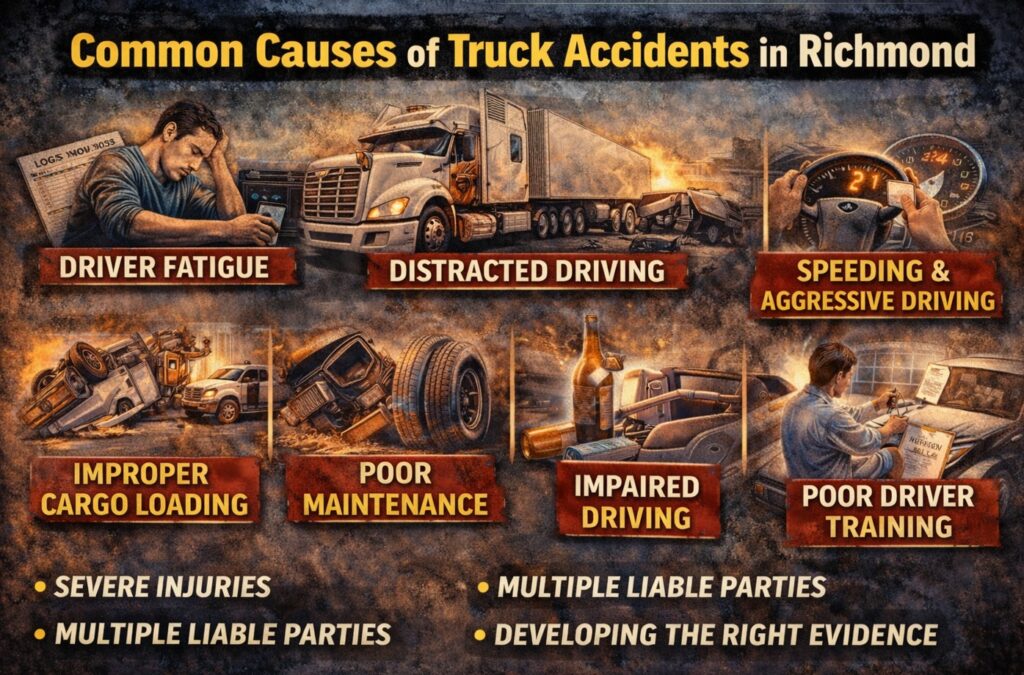
Common Causes of Richmond Truck Accidents at a Glance
| Potential cause | Important evidence | Parties that may require investigation |
|---|---|---|
| Driver fatigue | ELD records, logs, dispatch messages, fuel and toll records | Driver, motor carrier, dispatch provider |
| Distracted driving | Phone data, dash camera, telematics and witness accounts | Driver and, in limited cases, employer |
| Speeding or following too closely | Vehicle data, video, physical evidence and reconstruction | Driver and motor carrier |
| Unsafe lane change | Video, mirrors, side-camera data and vehicle damage | Driver and another involved motorist |
| Improper cargo loading | Bills of lading, loading records, photographs and securement equipment | Carrier, driver, loader, shipper or equipment provider |
| Poor maintenance | Inspection, repair, tire, brake and defect records | Carrier, owner, leasing company, maintenance provider or manufacturer |
| Unqualified driver | Driver qualification file, CDL, driving history and training documents | Driver and hiring motor carrier |
| Alcohol or drug impairment | Police records, toxicology and drug-and-alcohol testing documents | Driver and potentially the employer under a separate theory |
| Weather or road conditions | Weather reports, road photographs, work-zone plans and video | Driver, contractor, road authority or another motorist |
Get a free legal consultation
CALL 757-648-85791. Driver Fatigue
Fatigue can reduce attention, judgment and reaction time. It may contribute to lane departures, delayed braking, missed traffic signals or failure to recognise stopped traffic.
For property-carrying drivers subject to the standard federal hours-of-service rules, FMCSA generally provides:
- A maximum of 11 hours of driving after 10 consecutive hours off duty;
- No driving beyond the 14th consecutive hour after coming on duty; and
- A 30-minute interruption after eight cumulative hours of driving without a qualifying break.
Exceptions and alternative provisions may apply based on the operation.
Review the FMCSA hours-of-service summary.
Does an hours-of-service violation prove fatigue?
No. A violation may support an investigation, but the evidence must connect fatigue or the regulatory violation to the collision.
Likewise, legal compliance does not necessarily prove that a driver was alert. Fatigue may result from:
- Poor-quality sleep
- Overnight driving
- Illness
- Sleep disorders
- Medication
- Long loading or unloading periods
- Several consecutive workdays
- Travel to and from the terminal
What records may show fatigue?
Potential evidence includes:
- Electronic logging device data
- Paper records of duty status
- Dispatch and routing messages
- GPS and telematics
- Fuel and toll receipts
- Bills of lading
- Hotel and parking receipts
- Payroll and trip records
- Loading and delivery times
Not every driver is required to use an ELD. Short-haul operations and other federal exceptions may apply.
2. Distracted Driving
Commercial drivers may become distracted by:
- Text messages
- Handheld telephone calls
- Dispatch systems
- GPS input
- Food or drinks
- Paperwork
- In-cab equipment
- Activity outside the vehicle
FMCSA prohibits covered commercial drivers from texting while driving and restricts holding or unsafely reaching for a mobile telephone.
A mounted navigation or dispatch device is not automatically unlawful. The investigation should determine whether the driver typed, read messages, reached unsafely or otherwise failed to watch traffic.
What distracted-driving evidence may exist?
- Phone-use records
- Dispatch messages
- Dash-camera footage
- Inward-facing camera footage
- Telematics
- Witness statements
- Vehicle-event data
- Police body-camera footage
Phone contents and detailed usage records generally require appropriate legal process.
Contact our personal injury lawyers today
GET FREE EVALUATION3. Speeding or Driving Too Fast for Conditions
Higher speed increases the distance required to identify a hazard, react and stop. It can also increase impact force and reduce the time available to respond to congestion, a traffic signal or a vehicle entering the lane.
Unsafe speed may involve:
- Exceeding the posted limit
- Driving too fast for rain or fog
- Entering a curve or ramp too quickly
- Failing to reduce speed in construction
- Approaching stopped traffic too quickly
- Ignoring a lower company-governed speed
Potential speed evidence includes vehicle data, GPS, dash-camera video, skid or tire marks, police measurements and accident reconstruction.
4. Following Too Closely
A loaded commercial vehicle may require substantial distance to stop safely. A truck driver who follows too closely may be unable to avoid a rear-end collision when traffic slows suddenly.
The investigation should also consider:
- Whether another vehicle entered the truck’s lane;
- Whether brake lights were functioning;
- Whether traffic stopped because of an earlier collision;
- Weather and roadway conditions;
- Truck speed and brake condition; and
- Whether the driver was distracted or fatigued.
A rear impact does not automatically resolve every question of fault.
5. Unsafe Lane Changes and Turns
A tractor-trailer requires more space to merge, change lanes and turn than a passenger vehicle. A side-impact or underride collision may occur when:
- The truck enters an occupied lane.
- The driver fails to signal.
- Mirrors are improperly adjusted.
- A camera or warning system does not function.
- The truck makes a wide right turn.
- Another motorist attempts to pass during a turn.
- Either driver remains in a position that is difficult to observe.
Calling the event a “blind-spot accident” does not decide responsibility. The evidence must establish what each driver could see and whether reasonable care was used.
6. Improperly Loaded or Unsecured Cargo
Unbalanced, overloaded or inadequately secured cargo may contribute to:
- Trailer sway
- Rollover
- Jackknifing
- Extended stopping distance
- Axle or tire failure
- Cargo falling into traffic
- Loss of steering control
Federal cargo-securement rules generally require covered cargo to be immobilised or restrained through structures, blocking, bracing, tiedowns or other suitable methods.
Who may be responsible for a cargo problem?
Depending on who controlled the work and what could reasonably be inspected, the investigation may include:
- The motor carrier
- The driver
- A third-party loading company
- The shipper
- A warehouse operator
- A securement-equipment supplier
The fact that another company loaded the trailer does not automatically eliminate the driver’s or carrier’s responsibilities. Conversely, the driver may not have had access to inspect sealed or specialised cargo.
Important cargo evidence
- Bills of lading
- Weight tickets
- Loading diagrams
- Trailer photographs
- Seal information
- Securement equipment
- Loader and driver training records
- Inspection and recheck records
- Contracts allocating loading duties
7. Poor Maintenance or Mechanical Failure
Potential mechanical causes include:
- Worn or improperly adjusted brakes
- Defective tires
- Steering failure
- Lighting defects
- Coupling failure
- Suspension damage
- Trailer-door failure
- Defective safety equipment
Covered motor carriers generally must systematically inspect, repair and maintain vehicles under their control and keep safety-related parts in proper condition.
Who controlled the truck?
The registered owner, motor carrier, tractor lessor, trailer owner and maintenance provider may be different companies.
Potential records include:
- Preventive-maintenance schedules
- Repair orders
- Driver inspection reports
- Annual inspection records
- Roadside inspection reports
- Brake and tire measurements
- Reported defects
- Recall notices
- Invoices and service contracts
A broken part does not automatically prove negligent maintenance. Product defects, road hazards and sudden failures may require separate evaluation.
8. Unqualified, Inexperienced or Improperly Supervised Drivers
Commercial vehicles may require specialised licences, endorsements, medical qualifications and operating skills.
A driver-qualification investigation may examine:
- Licence class and endorsements
- Employment application
- Driving history
- Prior safety-performance information
- Road-test documentation
- Medical certification
- Training records
- Previous crashes or violations
- Employer knowledge of performance problems
Federal rules generally require covered motor carriers to maintain qualification files for employed drivers. The precise contents and retention periods depend on the record.
A driver’s error during one trip does not, by itself, prove negligent hiring or training by the carrier.
9. Alcohol or Drug Impairment
Commercial-driver alcohol standards are stricter than the ordinary 0.08% criminal threshold commonly associated with passenger vehicles. FMCSA uses an alcohol concentration of 0.04% for disqualification of a CDL driver operating a commercial motor vehicle.
Potential impairment evidence includes:
- Police observations
- Breath or blood results
- Post-accident testing
- Controlled-substance records
- Body-camera footage
- Witness statements
- Criminal-court records
An alcohol or drug violation does not automatically establish that impairment caused the collision. Civil liability, causation and damages must still be proved.
Learn more about drunk driving accident claims in Richmond.
10. Unsafe Weather or Work-Zone Driving
A commercial driver may need to slow down, increase following distance or stop operating when conditions become unsafe.
Relevant conditions may include:
- Heavy rain
- Fog
- Snow or ice
- High winds
- Standing water
- Narrow work-zone lanes
- Temporary lane shifts
- Poor lighting
- Obstructed signs
A contractor or government entity may require investigation when road design or temporary traffic control contributed to the crash. Government claims may involve immunity and special notice requirements.
11. Unsafe Scheduling or Dispatch Practices
A motor carrier may require investigation when it allegedly:
- Set an unrealistic delivery schedule;
- Pressured a fatigued driver to continue;
- Ignored an hours-of-service warning;
- Dispatched a vehicle with an unresolved safety defect;
- Failed to respond to a driver’s safety concern; or
- Used inaccurate or altered records.
A demanding schedule alone does not establish negligence. The communications, actual operating conditions and connection to the crash must be examined.
12. Negligence by Another Driver
A truck collision is not always caused exclusively by the truck driver or carrier.
Another motorist may contribute by:
- Cutting closely in front of the truck;
- Entering an occupied lane;
- Stopping without adequate warning;
- Driving while distracted or impaired;
- Passing unsafely; or
- Creating a chain-reaction collision.
Several drivers may be investigated, but Virginia’s contributory-negligence rule makes evidence of the injured person’s own conduct particularly important.
Why Richmond Truck Accident Investigations May Be Complex
The Richmond region sits at the intersection of major freight routes, including I-95, I-64 and I-295. The I-95/I-64 overlap and surrounding interchanges combine commercial traffic, commuters, local vehicles and construction activity.
A Richmond collision may involve:
- An interstate motor carrier
- An intrastate carrier
- A national delivery company
- An independent owner-operator
- A leased tractor or trailer
- A local cargo or maintenance contractor
- Several insurance policies
The business name displayed on the truck may help identify an entity, but ownership, employment, operating authority and contractual relationships should be verified.
Who May Be Liable?
Depending on the evidence, potentially responsible parties may include:
- The truck driver
- The motor carrier
- The tractor or trailer owner
- A leasing company
- A cargo loader or shipper
- A maintenance contractor
- A parts or vehicle manufacturer
- Another driver
- A road contractor or government authority
Each proposed defendant requires a separate factual and legal basis. Merely being connected to the shipment or vehicle does not establish liability.
What Evidence Should Be Preserved?
Potentially important evidence includes:
- Electronic control module or event data
- ELD records and supporting documents
- GPS and telematics
- Forward-facing and inward-facing video
- Dispatch communications
- Driver qualification records
- Inspection and maintenance records
- Post-crash testing records
- Bills of lading and cargo documents
- Weight tickets
- Cellphone records when legally obtainable
- Police and witness evidence
- Photographs of the vehicles and road
- Contracts, leases and insurance policies
Different systems retain information for different periods. A prompt preservation request may help prevent routine deletion or overwriting.
Do not repair, sell or destroy a seriously damaged vehicle before determining whether an inspection is needed.
How Does Virginia Contributory Negligence Affect the Claim?
Virginia generally follows contributory negligence.
A defendant may allege that the injured person:
- Made an unsafe lane change;
- Was speeding;
- Passed the truck unsafely;
- Followed too closely;
- Was distracted; or
- Failed to maintain a proper lookout.
An allegation is not proof. The evidence must establish both negligent conduct and a causal relationship to the collision.
What Compensation May Be Available?
When liability, causation and damages are established, potential compensation may include:
- Emergency medical care
- Past medical expenses
- Reasonably anticipated future treatment
- Rehabilitation
- Lost income
- Reduced earning capacity
- Physical pain and inconvenience
- Mental anguish
- Scarring and disfigurement
- Permanent impairment
- Vehicle and personal-property damage
Compensation is not automatic. The amount depends on the evidence, available insurance, legal defences and individual losses.
Serious cases may also involve a Richmond brain injury claim or a Richmond wrongful death claim.
How Long Do You Have to File?
Under Virginia Code § 8.01-243:
- A personal injury action generally must be filed within two years after accrual.
- A property-damage action generally must be filed within five years after accrual.
A Virginia wrongful death action generally must be filed by the personal representative within two years after death.
Different deadlines or notice requirements may apply when:
- The injured person is a minor or incapacitated;
- A government entity may be responsible;
- A defendant cannot initially be identified;
- A previous action was dismissed or nonsuited; or
- Another statute controls.
An insurer’s investigation, FMCSA review or settlement negotiation does not necessarily extend the filing period.
Frequently Asked Questions
Does a federal trucking violation automatically prove liability?
No. The claimant must establish that an applicable duty was violated and that the violation caused or contributed to the collision and injury.
Do all commercial trucks use electronic logs?
No. The ELD requirement applies to most drivers required to maintain records of duty status, but several exceptions exist.
Is the trucking company always responsible for its driver?
Not automatically. Employment, agency, operating authority, contractual relationships and the conduct involved must be reviewed.
Can a loading company be responsible?
Potentially, when its unreasonable loading or securement work caused the collision. The driver’s and carrier’s separate inspection duties may also require evaluation.
Does mechanical failure prove poor maintenance?
No. Maintenance records, inspections, product condition and the nature of the failure must be examined.
Can more than one company be liable?
Potentially. A claim may involve a driver, motor carrier, owner, loader, maintenance provider or another entity, but each requires a supported legal theory.
Does a police report identify every liable party?
No. Police reports may identify vehicles and preliminary observations, but commercial relationships and regulatory records usually require additional investigation.
How quickly should trucking records be requested?
Promptly. Some video, telematics and communication records may be overwritten through routine retention practices.
How long do I have to file?
A Virginia personal injury action generally must be filed within two years, subject to other statutes and circumstances.
Does hiring a lawyer guarantee compensation?
No. The outcome depends on duty, breach, causation, damages, evidence, insurance and legal defences.
Discuss a Richmond Truck Accident With Atkinson Law
A commercial truck accident may require investigation of electronic vehicle data, federal safety records, cargo documents, maintenance history, several businesses and multiple insurance policies.
Atkinson Law serves injured people in Richmond and can review:
- The collision and police investigation
- The vehicle and carrier involved
- Applicable federal and Virginia requirements
- Driver, cargo and maintenance records
- Potentially responsible parties
- Medical and financial losses
- Virginia filing deadlines
Call or text 757-648-8579 or contact Atkinson Law to request a consultation.
Call or text 757-648-8579 or complete a Free Case Evaluation form
CONTACT US TODAY